Start with where drivers fill up: on 5 August the ACCC found diesel gaps of 23 to 36 cents a litre between servos in Sydney, Brisbane and Perth. Then cut load, roof-rack drag, speed and idling, which the Green Vehicle Guide links to higher fuel use. Measure litres per 100 km per vehicle before and after.
Key takeaways
- The ACCC put average retail diesel across the five largest cities at 275.8 cents a litre on 4 November 2026.
- At 11am on 5 August 2026 the ACCC found diesel 23.0 cents a litre apart between the cheapest and dearest Sydney sites, and 36.4 cents apart in Brisbane.
- The Green Vehicle Guide says driving at 110 km/h can use up to 25% more fuel than at 90 km/h.
- Air resistance from external loads such as roof racks can lift fuel consumption by over 20% in some cases, according to the Green Vehicle Guide.
- Measuring litres per 100 km per vehicle before and after a change shows whether it worked, without any device in the vehicle.
Diesel is expensive this year, and a newer, thriftier ute is not on the cards for most small businesses. The good news is that the two biggest levers on a fuel bill cost nothing to pull: where your drivers fill up, and how the vehicle is loaded and driven.
Most guides to cutting fleet fuel costs are written by telematics companies, so they lead with hardware, route optimisation and fuel cards. This one starts with what four utes and a phone can do this week.
How much is fuel costing a small fleet right now?
The ACCC has been reporting fuel prices weekly since March 2026, in response to the conflict in the Middle East. Its report of 6 November 2026 put the daily average retail diesel price across the five largest cities at 275.8 cents per litre on 4 November.
That was 99.2 cents a litre higher than on 20 February, around a week before the conflict escalated, and 46.6 cents lower than on 31 March, when prices were around their peak. Petrol across the same five cities averaged 232.7 cents a litre on 4 November.

At those prices every litre a driver does not need, and every fill at a dearer servo than necessary, shows up in the monthly fuel spend.
Is it worth driving to a cheaper servo?
Usually, yes, because the gap between servos in the same city can be far bigger than most people assume. In its 7 August 2026 report the ACCC published the lowest and highest priced diesel it found in each capital city at 11am on 5 August:
| City | Lowest priced diesel | Highest priced diesel | Gap |
|---|---|---|---|
| Sydney | 230.9c | 253.9c | 23.0c |
| Melbourne | 235.3c | 329.9c | 94.6c |
| Brisbane | 232.5c | 268.9c | 36.4c |
| Adelaide | 242.5c | 250.9c | 8.4c |
| Perth | 228.5c | 256.9c | 28.4c |
That is one moment on one day, and the extreme ends of a city are rarely both on a driver’s route. But the ACCC’s own conclusion is the useful part: there can be a significant difference between the lowest and highest priced retail sites in some cities, and it encourages motorists to use free fuel price apps and websites to shop around. It repeats that advice in its November report.
What does a 20 cent gap add up to across four utes?
Here is an illustrative example, using round numbers to show the arithmetic rather than anyone’s actual bill. Four utes each take on 80 litres a week.
| Price gap per litre | Per fill | Per week, 4 utes | Per year, 4 utes |
|---|---|---|---|
| 10c | $8.00 | $32.00 | $1,664 |
| 20c | $16.00 | $64.00 | $3,328 |
| 30c | $24.00 | $96.00 | $4,992 |
The saving does not come from finding the cheapest servo in the city. It comes from not filling at the dearest one on the way past, which is what happens when a driver stops wherever the gauge runs low.

Which driving habits burn the most fuel?
The Green Vehicle Guide, run by the federal infrastructure department, publishes a short list of what makes a difference with the vehicle you already have. For a work ute, four of them stand out.
- Speed. At 110 km/h a car can use up to 25% more fuel than at 90 km/h, according to the Guide. Unnecessary acceleration adds to it.
- Idling. The Guide says switching the engine off, even for a short period, saves more fuel than the burst used to restart it. A ute left running outside a job while someone grabs a part is burning fuel to go nowhere.
- Gears. Most engines run most efficiently at around 1,500 to 2,500 rpm, so changing up before 2,500 rpm helps. In an automatic, easing back slightly on the accelerator once the vehicle builds speed lets it shift up sooner.
- Following distance. Keeping a good gap avoids the abrupt braking and re-acceleration that wastes fuel.
None of these needs a device in the vehicle. They need a conversation with your drivers, and something to measure the result against.
Does what’s on the ute matter?
More than most tradies would guess. The Guide puts it plainly: the more a vehicle carries, the more fuel it uses. It also says increased air resistance can lift fuel consumption, in some cases by over 20%, and suggests only carrying extra parts on the outside, such as roof racks, when necessary.
That does not mean taking the ladder rack off a plumber’s ute. It means asking a few questions about each vehicle:
- Is the tray carrying stock and tools that never come off it?
- Is a roof rack or pod on a ute that rarely uses it?
- Is the trailer hitched for the whole day when it is only needed for one job?
The cheapest litre is the one the ute never burns. Load, speed and idling cost nothing to fix.
What maintenance actually saves fuel?
Two things, according to the Guide. Keep the vehicle serviced, because a well-tuned vehicle costs less to run. And look after the tyres: inflate them to the highest pressure the tyre manufacturer recommends, keep the wheels properly aligned, and keep the spare inflated too. The Guide notes that tyres with lower rolling resistance can also help.
Tyre pressure is the easiest of these to let slip on a busy fleet, because nobody owns the job. A monthly check at the same servo you fill at is enough to stop it drifting.
How do you know any of this is working?
You measure fuel use per vehicle before and after. The simplest way is the full-to-full method: fill to the first click, note the odometer, and at the next fill divide the litres by the kilometres and multiply by 100. Our guide to working out each ute’s fuel consumption from fill-ups walks through it, including what to check when one vehicle uses more than the rest.
Track two numbers for a month before you change anything: litres per 100 km for each vehicle, and the average price per litre each driver paid. Change one thing, then compare the next month. If the price per litre drops but consumption does not, the servo habit worked and the driving habit did not, or the other way round.

When is a spreadsheet enough?
For one or two vehicles and an owner who does all the filling, a spreadsheet and a free fuel price app will do. The ACCC points to free-to-use apps and websites as the way to shop around, and for a single driver in a single city that is all you need.
It gets harder with several drivers. Each one fills wherever is convenient, the receipts end up in different gloveboxes, and working out who paid what per litre means typing in every fill. Our earlier post on whether there is a cheapest day to fill up covers why, for diesel, where you buy matters more than when.
Where does Axlerun fit?
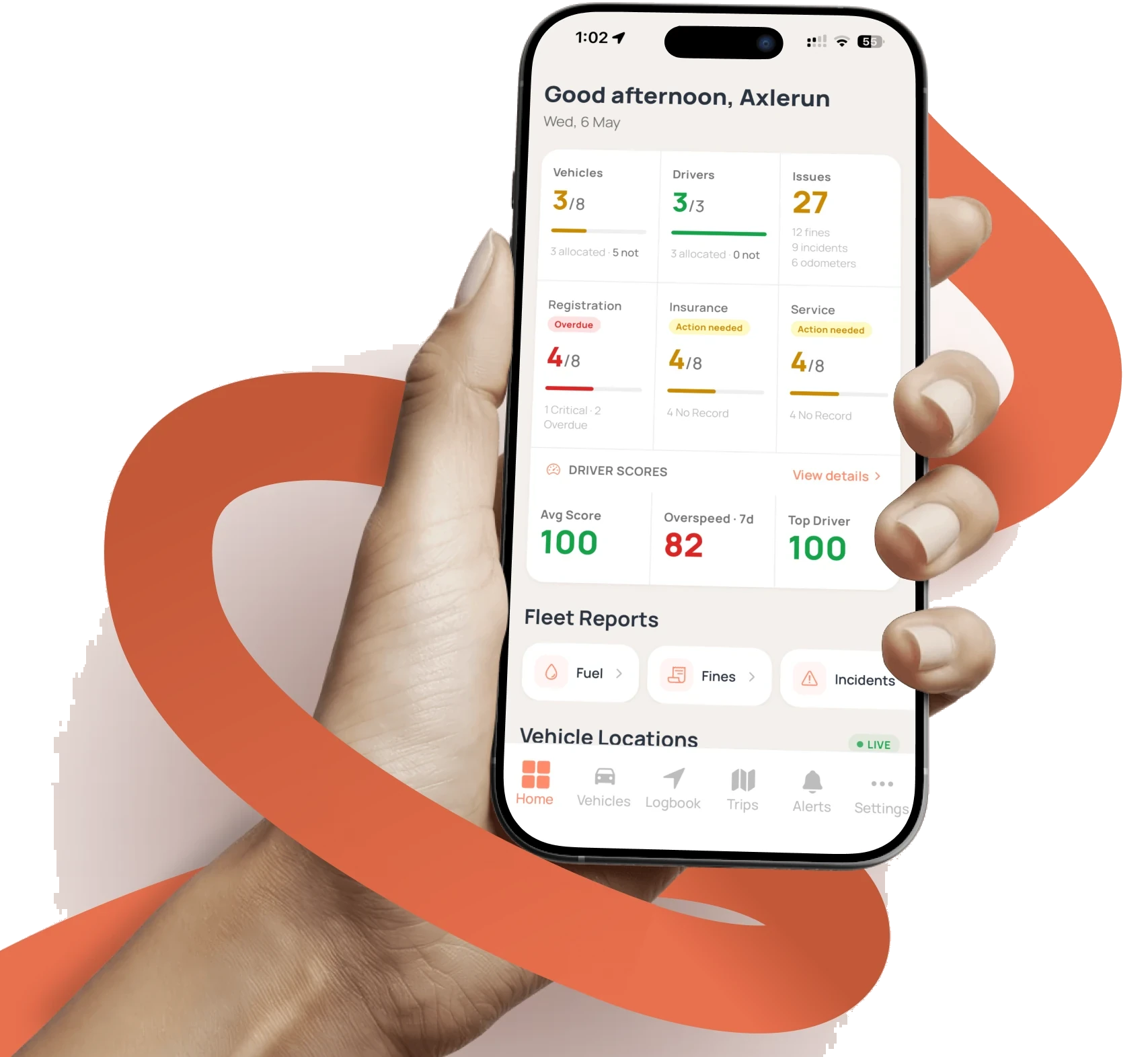
The Fuel & EV Locator shows the cheapest fuel near each vehicle, with the brand, the current price, how far away it is and when that price was last updated. It covers NSW, Queensland, South Australia, Victoria and Western Australia, the states that publish live government fuel prices, and it is free on every plan including Drive.
Each fill can be logged against the vehicle with the litres, price per litre, total and odometer, or filled from a photo of the receipt. That puts the price per litre and the consumption figures for each ute in one place, without collecting slips. On Cruise, every fill also rolls into that vehicle’s running costs over three, six and twelve months. The first three vehicles are free forever, and there is no hardware to fit.
Frequently asked questions
What is the quickest way to cut a small fleet's fuel costs?
Change where drivers fill up. On 5 August 2026 the ACCC found the cheapest and dearest diesel in Sydney 23.0 cents a litre apart, and 36.4 cents apart in Brisbane. The ACCC encourages motorists to use free fuel price apps and websites to compare prices before filling, which costs nothing and needs no new equipment.
How much fuel does idling waste?
The Green Vehicle Guide does not put a single figure on it, but it says switching the engine off, even for a short period, saves more fuel than the burst used to restart it. For a work ute left running outside a job, the practical rule is simple: if the vehicle is not moving and nobody needs the air conditioning, switch it off.
Does speed really change fuel use that much?
Yes. The Green Vehicle Guide says a car can use up to 25% more fuel at 110 km/h than at 90 km/h, and that unnecessary acceleration also increases consumption. Keeping a good distance from the vehicle in front avoids abrupt braking and the extra fuel needed to get back up to speed.
Do roof racks and trailers increase fuel consumption?
They can. The Green Vehicle Guide says the more a vehicle carries the more fuel it uses, and that increased air resistance can raise fuel consumption, in some cases by over 20%. It suggests carrying extra parts on the outside of the vehicle, such as roof racks, only when necessary.
What tyre pressure saves the most fuel?
The Green Vehicle Guide recommends inflating tyres to the highest pressure recommended by the tyre manufacturer, keeping wheels properly aligned and keeping the spare inflated. It adds that tyres with lower rolling resistance can also help reduce fuel consumption. Check the manufacturer's figure for your tyres rather than a general number.
How can I tell if fuel-saving changes are working?
Measure litres per 100 km for each vehicle for a month, using full-to-full fills and odometer readings, along with the average price per litre each driver paid. Make one change, then compare the next month. If price per litre falls but consumption does not, the servo habit worked and the driving habit has not changed yet.
Sources
- 1.Weekly fuel price monitoring report, 6 November 2026, Australian Competition and Consumer Commission
- 2.Weekly fuel price monitoring update, Australian Competition and Consumer Commission
- 3.Weekly fuel price monitoring report, 7 August 2026, Australian Competition and Consumer Commission
- 4.Tips to reduce your emissions, Green Vehicle Guide (Australian Government)
Axlerun is fleet software, not a tax agent. Rates and rules change, confirm anything that affects your return with your accountant or the ATO.
Fleet admin, minus the admin.
A short roundup a week (FBT, rego, fuel and fines) plus the occasional Axlerun update. No spam, unsubscribe any time.