Fill the tank to the first click and note the odometer. At the next fill, fill to the first click again, then divide the litres added by the kilometres driven and multiply by 100. That is your real L/100km. Average three or four fills per ute before comparing, because the windscreen label is a laboratory figure.
Key takeaways
- The windscreen fuel label on a new vehicle comes from a controlled laboratory test, and the federal infrastructure department says drivers generally see higher consumption on the road.
- The Green Vehicle Guide names load, towing, traffic, weather, air conditioning and driving style as the factors a lab test strips out.
- Under ADR 81/02 the label shows only the combined figure; the urban figure is the better guide for vehicles driven mostly in city traffic.
- ADR 81/03 moves new vehicle models to the WLTP lab test from 1 July 2026, with urban and extra-urban figures replaced by Low, Medium, High and Extra High values.
- For sole traders and partnerships using the ATO logbook method for a car, odometer readings on which fuel and oil use is estimated are one of the accepted records.
Every ute in your fleet has a fuel figure on a sticker somewhere. It came off the windscreen the week the vehicle arrived, and it was never going to match what that ute does carrying a toolbox, a ladder rack and a driver who is running late.
The useful number is the one your own fill-ups produce. It costs nothing to work out, it needs two readings you probably already half-record, and once you have it for every vehicle it tells you which ute is quietly costing you the most.
Why doesn’t the windscreen figure match what your ute uses?
The windscreen label is a laboratory result. The Green Vehicle Guide says every vehicle it lists must display the label when sold new, and the figure comes from a test procedure set by the Australian Design Rules, run under standardised, carefully controlled conditions in emission laboratories. That covers new light vehicles up to 3.5 tonnes gross vehicle mass.
The point of a controlled test is comparison. Every vehicle runs the same cycle, so you can line up two utes in a showroom on a fair basis. The federal infrastructure department says plainly that drivers will generally see higher fuel consumption on the road than the lab test reports.
The Green Vehicle Guide lists what the lab strips out, and it reads like a description of a trade ute’s working day:
- traffic and weather conditions
- the load being carried or towed
- air conditioning and heating
- how the driver speeds up and slows down

How big is the gap between the label and the road?
There is now a national program measuring exactly that. The Australian Government committed $14 million over four years, from 2022–23 to 2025–26, to real-world testing run by the Australian Automobile Association, with a portable emissions measurement system fitted to each vehicle’s exhaust while it is driven on the road.
When the program was announced in October 2022, the government cited the AAA’s pilot study: 29 of 30 popular models used more fuel than advertised when tested outside the lab. The department’s own description of the program says the testing covers vans and utes as well as cars and SUVs, and results are published at realworld.org.au.
A higher real-world figure does not mean a vehicle breaks the rules. The department says the Design Rules require vehicles to meet limits in the controlled laboratory test, so a ute that uses more on the road is not, on that basis alone, non-compliant.
Which figure on the label is closest to how your ute is driven?
Vehicles certified under ADR 81/02, the labelling rule in force for new vehicles since 1 April 2009, are tested on two cycles. The Green Vehicle Guide describes them like this:
| Test cycle | What it simulates | Closer to |
|---|---|---|
| Urban | Average speed 19 km/h, about 30% idling, frequent stop-start | Suburban job runs and city traffic |
| Extra-urban | Average speed 63 km/h, peak of 120 km/h | Freeway and highway driving |
| Combined | Both cycles together | The headline number on the label |
The Guide notes that the label itself only displays the combined value, even though the urban and extra-urban results can be far apart. For a driver who spends most of the day in city traffic, it says the urban figure is the better indication. A ute doing suburban job runs all day is likely to sit closer to the urban figure than the combined one.
That is changing for newer models. ADR 81/03 moves labelling to the WLTP lab test for new vehicle models from 1 July 2026, and to all applicable vehicles by 1 July 2028. Under WLTP the urban and extra-urban figures are replaced by Low, Medium, High, Extra High and Combined values, so a ute bought new in the next couple of years may not carry an urban figure at all.
How do you work out L/100km from your own fill-ups?
The reliable way is the full-to-full method. It only needs the pump and the odometer.
- 1Fill the tank to the first click and write down the odometer reading.
- 2Drive as normal. If a driver tops up partway, keep that receipt and add its litres to the next total.
- 3At the next fill, fill to the first click again and note the litres and the new odometer reading.
- 4Divide the litres by the kilometres driven, then multiply by 100.
The litres you pour in at the second fill are the litres the ute burned since the first one. That is why both fills have to go to the same point.

A single tank is noisy. One week of towing or a long highway run will swing it either way. Three or four consecutive fills give you a figure you can compare between vehicles, and a rolling average over a month or two is better still.
What does that look like across four utes?
Here is an illustrative month for a four-ute business, using made-up readings to show the method. Each row is one full-to-full interval.
| Vehicle | Kilometres between fills | Litres at second fill | L/100km |
|---|---|---|---|
| Ute 1 | 820 | 86 | 10.5 |
| Ute 2 | 790 | 83 | 10.5 |
| Ute 3 | 760 | 99 | 13.0 |
| Ute 4 | 850 | 92 | 10.8 |
| Fleet | 3,220 | 360 | 11.2 |
Ute 3 stands out. It is not necessarily a fault. It might carry the heaviest load, tow the trailer, or do the most stop-start work. But it is now a question you can ask the driver, rather than a cost buried in the monthly fuel card statement.
What should you check when one ute is using more than the others?
Start with the things the Green Vehicle Guide names, because they are the ones that move the number most: load, towing, traffic, air conditioning and driving style. Then look at the vehicle itself. The Guide also lists the condition of the vehicle as a reason real-world figures vary from the lab.
A useful order to work through:
- Same job, same load? Compare it with a ute doing similar work before blaming the vehicle.
- Trailer or roof load? A ladder rack or a trailer on half its runs will lift its figure.
- Who drives it? How a driver speeds up and slows down is on the Guide’s list too.
- When was it last serviced? Vehicle condition is on the government’s own list.
A figure from your own fill-ups is the only one that reflects your loads, your routes and your drivers. The label is for comparing vehicles in a showroom.
If the gap persists after a service and the work is comparable, that is the point to talk to your mechanic.
Do your fuel records matter for tax as well?
They can. For sole traders and partnerships using the logbook method for a car, the ATO lists the records to keep: the logbook, evidence of your other car expenses, and either evidence of actual fuel and oil costs or odometer readings on which you estimate your fuel and oil use.
The logbook itself also has to include odometer readings at the start and end of the logbook period. So the same odometer habit that gives you L/100km is one the ATO already expects. Whether the logbook method suits your business, and how fuel should be claimed, is a question for your accountant.
If you photograph receipts rather than keep paper, the ATO has views on what that photo needs to show. Our guide to scanning fuel receipts for the ATO covers it.
When is a spreadsheet enough?
For two or three utes and one person doing the fuel, a spreadsheet works. Four columns per vehicle (date, odometer, litres, price) and one formula is all it takes. The difficulty is not the maths. It is getting every driver to write down the odometer at every fill, and getting those notes out of the glovebox and into the sheet.
Once you are past a handful of vehicles, or more than one person fills them, the spreadsheet usually goes stale before the formula fails.

Where does Axlerun fit?
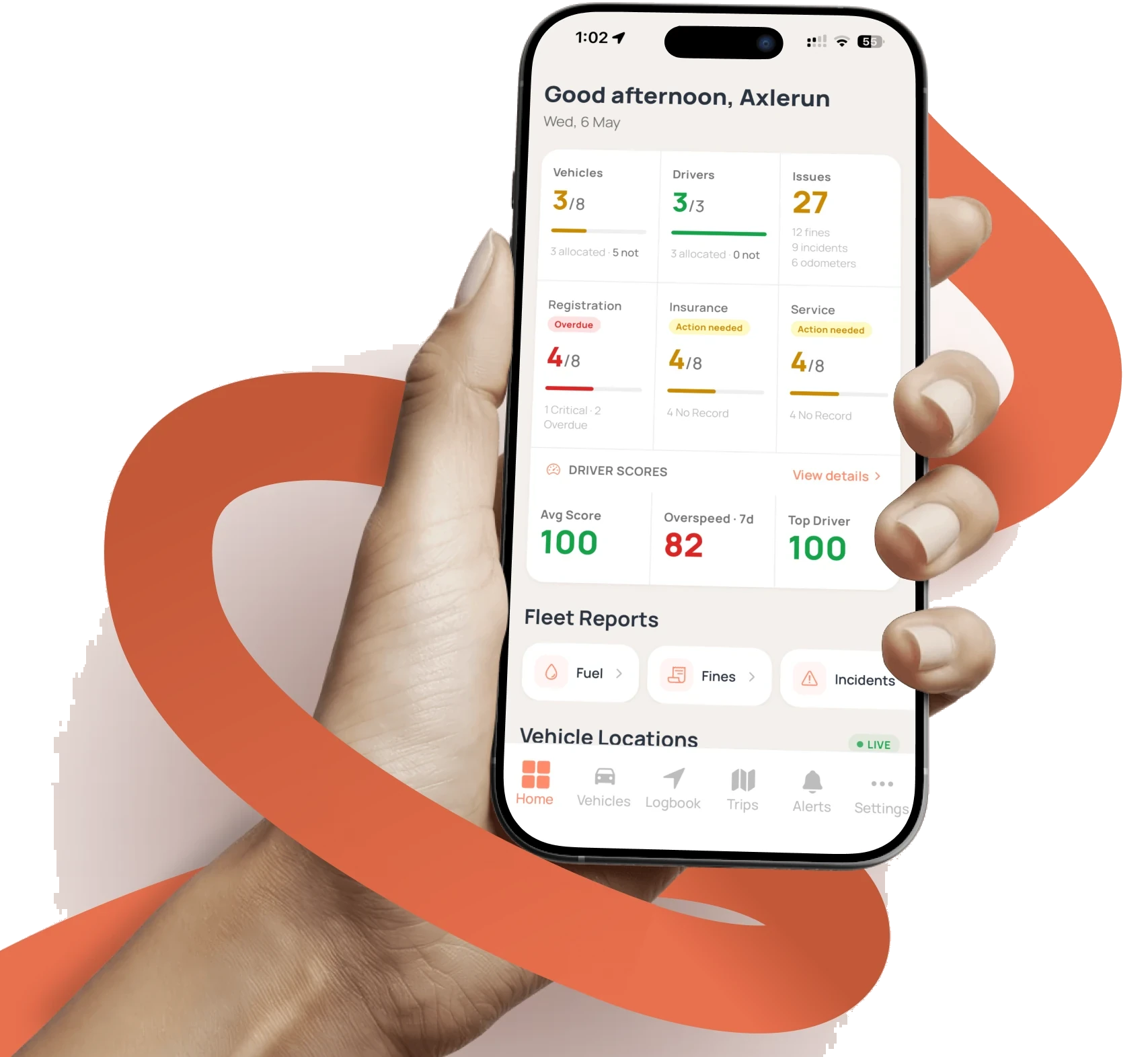
Axlerun’s fuel record captures the date, fuel type, litres, price per litre, total and odometer for each fill, against the vehicle, from the driver’s phone at the pump. Scan Receipt fills the form from a photo on any plan. That puts the two numbers this method needs in one place for every ute, without collecting slips.
The Fuel & EV Locator sits beside it, free on every plan including Drive. It shows the cheapest fuel near each vehicle, with the price and when it was last updated, in NSW, Queensland, South Australia, Victoria and Western Australia, where state governments publish live prices. On Cruise, every fill also rolls into that vehicle’s three, six and twelve-month running costs. The first three vehicles are free forever, and there is no hardware to fit.
If diesel versus petrol is the bigger question for your next vehicle, our comparison of petrol and diesel running costs for a work vehicle uses the same per-kilometre thinking.
Frequently asked questions
How do I calculate L/100km for my ute?
Fill the tank to the first click and record the odometer. At the next fill, fill to the first click again and note the litres and the new odometer reading. Divide the litres by the kilometres driven since the first fill and multiply by 100. Repeat over three or four fills and average them, because a single tank can be skewed by one week of towing or highway driving.
Why does my ute use more fuel than the sticker says?
The sticker is a laboratory result from a standardised test set by the Australian Design Rules. The Green Vehicle Guide says the lab controls for traffic, weather, the load carried or towed, air conditioning and how the driver accelerates and brakes. A working ute deals with all of those, so the federal infrastructure department says on-road consumption is generally higher than the lab figure.
Which label figure should I use for a ute driven around the suburbs?
For vehicles labelled under ADR 81/02, the Green Vehicle Guide says the urban figure is a better indication than the combined figure for drivers who spend a lot of time in city traffic. The urban test cycle averages 19 km/h with about 30% idling and frequent stop-start. The label itself shows only the combined value, so check the urban figure on the Green Vehicle Guide.
Is a ute that uses more fuel than its label non-compliant?
No. The federal infrastructure department says the Australian Design Rules require vehicles to meet their limits in a controlled laboratory test. Higher fuel use on the road does not, on its own, make a vehicle non-compliant. If one ute in your fleet uses far more than a similar one doing similar work, check its load, its towing and its service history first.
Where can I find real-world fuel figures for a ute?
The Australian Government funds a real-world testing program run by the Australian Automobile Association, with a portable measurement system fitted to each vehicle's exhaust on the road. The department says the program covers popular cars, SUVs, vans and utes, and the results are published separately from the Green Vehicle Guide at realworld.org.au.
Do I need fuel receipts for the ATO logbook method?
For sole traders and partnerships using the logbook method for a car, the ATO lists evidence of actual fuel and oil costs, or odometer readings on which you estimate your fuel and oil use, as the records to keep, alongside the logbook and evidence of other car expenses. Your accountant can confirm which approach suits your business.
Sources
- 1.Fuel consumption label, Green Vehicle Guide (Australian Government)
- 2.Rankings and measurements, Green Vehicle Guide (Australian Government)
- 3.Real world emissions, Green Vehicle Guide (Australian Government)
- 4.Questions and answers: Real-World Testing of Vehicle Efficiency, Department of Infrastructure, Transport, Regional Development, Communications, Sport and the Arts
- 5.Real-world vehicle fuel testing program launches, Minister for Infrastructure, Transport, Regional Development and Local Government
- 6.Real-world data to shine a light on vehicle fuel use and emissions, Minister for Infrastructure, Transport, Regional Development and Local Government
- 7.Logbook method, Australian Taxation Office
Axlerun is fleet software, not a tax agent. Rates and rules change, confirm anything that affects your return with your accountant or the ATO.
Fleet admin, minus the admin.
A short roundup a week (FBT, rego, fuel and fines) plus the occasional Axlerun update. No spam, unsubscribe any time.