Once a removalist truck's gross vehicle mass tops 4.5 tonnes it is a heavy vehicle under the Heavy Vehicle National Law. That means a heavy vehicle licence class, load restraint performance standards and a chain of responsibility duty. Work and rest hour limits and work diaries start above 12 tonnes.
Key takeaways
- A vehicle is a heavy vehicle once its gross vehicle mass or aggregate trailer mass is more than 4.5 tonnes.
- Work and rest hour limits apply only to fatigue-regulated heavy vehicles — a GVM over 12 tonnes, or a combination totalling over 12 tonnes.
- Under standard hours a solo driver may work a maximum of 12 hours in any 24-hour period and must take 7 continuous hours of stationary rest.
- A work diary is required under standard hours once a driver works more than 100 kilometres from base.
- From 1 August 2026 the amended HVNL applies an explicit unfit-to-drive duty to every heavy vehicle over 4.5 tonnes GVM.
Most removalists never decide to become a heavy vehicle operator. They just buy a bigger truck.
One month you are running a van on a car licence. The next there is a pantech on the books, and a body of law that did not touch you in June applies in July. Here is where each line sits, and what each one costs you in admin.
What actually counts as a heavy vehicle?
The line is mass, not appearance. The NHVR defines a heavy vehicle as one with a gross vehicle mass (GVM) or aggregate trailer mass (ATM) of more than 4.5 tonnes.
GVM is not what the truck weighs today. It is the maximum it can weigh when fully loaded, as specified by the manufacturer — the number on the compliance plate. A half-empty truck rated at 6 tonnes GVM is still a heavy vehicle on an empty run home.
Trailers count on their own. A furniture trailer with an ATM over 4.5 tonnes is a heavy vehicle in its own right, whatever is towing it.
| GVM or ATM | What applies |
|---|---|
| Up to 4.5 tonnes | Class C licence, ordinary registration and road rules |
| More than 4.5 tonnes | Heavy Vehicle National Law, NHVR as regulator, heavy vehicle licence class, load restraint performance standards, chain of responsibility primary duty |
| More than 4.5 and under 12 tonnes | Light to medium heavy vehicle — the primary duty applies, but in most cases no HVNL work and rest hour limits |
| Over 12 tonnes, or a combination over 12 tonnes | Fatigue-regulated: work and rest limits and work diary rules apply |
Which licence does your driver actually need?
Getting this wrong is the fastest way to have a job stopped on the kerb. The classes below are Transport for NSW’s. The same class names are used elsewhere in Australia, but confirm the detail with your own licensing authority before you put someone in the seat.
| Class | What it covers | Before you can apply |
|---|---|---|
| C | Vehicles up to 4.5 tonnes GVM | — |
| LR | Rigid vehicles over 4.5 and up to 8 tonnes GVM | Class C held 1 year or more |
| MR | Rigid vehicles with 2 axles over 8 tonnes GVM | Class C held 1 year or more |
| HR | Rigid vehicles with 3 or more axles over 8 tonnes GVM | Class C held 2 years or more |
| HC | Articulated vehicles with 3 or more axles, and tow trailer combinations over 9 tonnes GVM | Class MR or HR held 1 year or more |
For LR, MR and HR, a towed trailer must not have a GVM of more than 9 tonnes. Past that you are into HC territory no matter what the truck itself is rated at.
The waiting periods are the part that bites. If you are planning a second truck next winter, whoever will drive it needs the prerequisite time on their licence now — there is no way to buy past two years of class C.
Do removalists have to keep a work diary?
Most do not. Work and rest hour limits apply to fatigue-regulated heavy vehicles, which the NHVR defines as a vehicle with a GVM over 12 tonnes, a combination where the total GVM or GCM is over 12 tonnes, a bus over 4.5 tonnes built to carry more than 12 adults, or a truck over 12 tonnes with a machine or implement attached.
A two- or three-truck removalist fleet usually sits under that. The NHVR’s own advice on light to medium heavy vehicles — more than 4.5 and less than 12 tonnes — says plainly that in most cases those drivers are not subject to HVNL work and rest hour requirements.

Over 12 tonnes it changes shape entirely. Standard hours become the default, and no accreditation is needed to run under them.
| In any period of | Maximum work time | Minimum rest required |
|---|---|---|
| 5½ hours | 5¼ hours work | 15 continuous minutes |
| 8 hours | 7½ hours work | 30 minutes, in blocks of 15 continuous minutes |
| 11 hours | 10 hours work | 60 minutes, in blocks of 15 continuous minutes |
| 24 hours | 12 hours work | 7 continuous hours stationary rest |
| 7 days | 72 hours work | 24 continuous hours stationary rest |
| 14 days | 144 hours work | 2 night rest breaks, plus 2 night rest breaks on consecutive days |
The diary itself turns on a distance line, not just a mass one. Under standard hours, a driver working more than 100 kilometres from base must carry a work diary. Under BFM, AFM, ACH or exemption hours it is required regardless of distance.
Local work still has to be recorded, just not in a diary. For drivers staying inside 100 kilometres of base, the record keeper must hold the driver’s name and licence details, the dates worked, the registration numbers driven, the base location, and the totals of work and rest time for each day and each week.
What changed on 1 August 2026?
The amended HVNL commenced on 1 August 2026, and one of its changes reaches every operator over 4.5 tonnes rather than only the big end of town.
From 1 August 2026 the reformed HVNL applies an explicit duty that drivers must not drive while impaired by fatigue or unfit to drive — to all heavy vehicles over 4.5 tonnes GVM, whether or not the driver is inside any work and rest hour limits.
That reads differently when you run a 6-tonne pantech. Being inside your hours is no longer the answer, because the light-to-medium class has no hours to be inside of. The question becomes whether you can show you managed fatigue as a risk at all.
The reform also starts the move from the National Heavy Vehicle Accreditation Scheme to the new Heavy Vehicle Accreditation scheme — operators already accredited have up to three years to transition — and adds Alternative Compliance Hours as an hours option under ACA–Fatigue accreditation.
What does chain of responsibility mean for a two-truck business?
The primary duty is the obligation to ensure, so far as is reasonably practicable, the safety of your transport activities. It is not just the driver’s. It reaches the business that employs the driver or owns the vehicle, and the businesses sending and receiving the goods.
For a removalist, “so far as is reasonably practicable” is mostly unglamorous:
- Keeping the truck maintained and roadworthy
- Restraining and placing loads properly
- Training drivers and checking they are competent for that vehicle
- Managing fatigue as a risk, even where no hours limits apply
- Preventing impairment from alcohol, drugs and distraction
None of that needs software. All of it needs evidence, because a duty you cannot demonstrate looks identical to a duty you ignored.
How should furniture actually be restrained?
The load restraint performance standards apply to all heavy vehicles, and they are written as forces rather than as a list of approved straps. The restraint system has to withstand 0.8g — 80% of the weight of the load — forwards, 0.5g sideways and rearwards, and 0.2g upwards where you are relying on friction.

For furniture that is a useful reframe. An 80 kilogram washing machine needs restraint that can hold roughly 64 kilograms of forward force in a hard stop. Blankets and one hopeful tie-down do not get there.
What does registration time look like?
Heavy vehicle registration is administered by each state and territory, so the process depends on where the truck is plated. The NSW version is a fair illustration of the shape of it.
Renewing a heavy vehicle registration in NSW needs the plate or billing number, a CTP green slip, inspection report results and the fee — and most vehicles will require an inspection. The two schemes have different shelf lives: an HVAIS report is valid for 42 days, an HVIS inspection for three months. NSW also offers 3-month and 6-month registration terms for trailers and heavy vehicles over 4.5 tonnes GVM.
That 42-day window is the one that catches people out. Inspect too early and the report lapses before renewal. Leave it too late and the truck is off the road on a Monday you had three jobs booked for.
What should you keep on file, and for how long?
Fatigue and work-hour records carry the strictest rule. They must be kept for three years after they are created, somewhere an authorised officer can get at them for an audit or investigation.

Two shorter clocks sit inside that one. Supplementary records must be kept in the vehicle for 28 days after they are created, and copies must reach the record keeper within 21 days.
| Record | How long | Where |
|---|---|---|
| Fatigue and work-hour records | 3 years from creation | Accessible to an authorised officer |
| Supplementary records | 28 days from creation | In the vehicle |
| Copies to the record keeper | Within 21 days | With the record keeper |
Everything else — inspection reports, registration expiry, maintenance history, incident notes, driver licence classes and their expiry dates — has no single legislated retention period. It is simply the file you reach for when someone asks you to show the primary duty was met, and catching a registration before someone drives on it is the cheapest win in the whole stack.
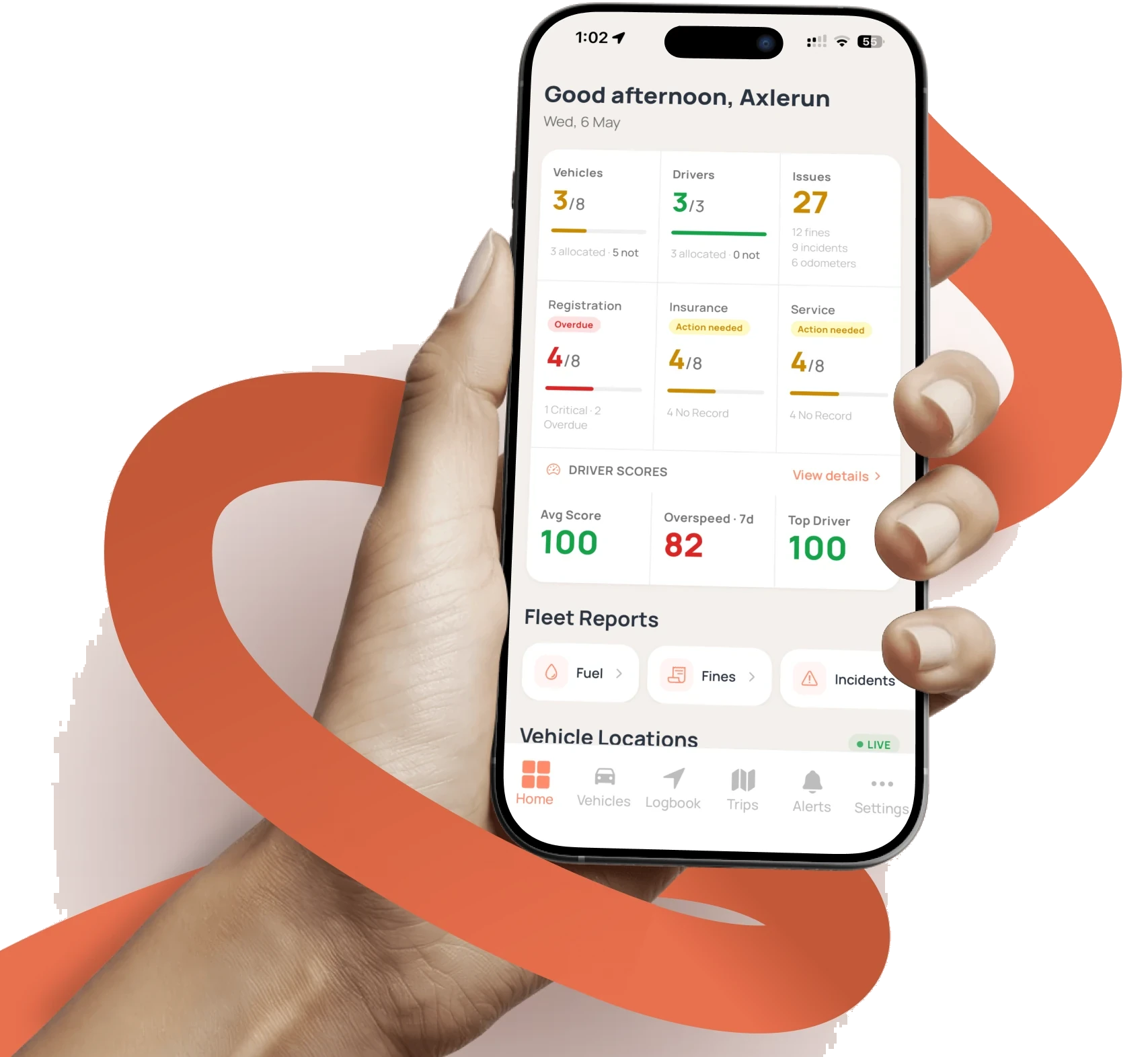
That file is what Axlerun is built for: vehicle profiles with registration expiry, inspection and maintenance reminders, condition reports before and after a job, and costs tracked against each truck. First three vehicles free forever, no hardware, export the lot whenever you want. It is not a work diary and it is not an NHVR-accredited fatigue system — over 12 tonnes you still need those, and none of this is legal or tax advice for your own position. If you want a hand setting it up for trucks rather than utes, get in touch.
Before the next truck goes on the books, check four things:
- 1The GVM on the compliance plate, not the tare weight
- 2The licence class held by everyone who will drive it
- 3Whether the combination tips over 12 tonnes
- 4When its next inspection falls due, and how long that report stays valid
Frequently asked questions
Is a removalist truck a heavy vehicle?
A truck is a heavy vehicle once its gross vehicle mass is more than 4.5 tonnes, or a trailer once its aggregate trailer mass is more than 4.5 tonnes. GVM is the maximum the vehicle can weigh when fully loaded, as specified by the manufacturer — not what it weighs on the day. Above that line the Heavy Vehicle National Law applies and the NHVR is the regulator.
What licence do you need to drive a removalist truck in Australia?
In NSW a class C licence covers vehicles up to 4.5 tonnes GVM. A light rigid (LR) licence covers rigid vehicles over 4.5 and up to 8 tonnes, and requires a class C held for a year or more. Medium rigid covers two-axle vehicles over 8 tonnes. Heavy rigid covers three or more axles over 8 tonnes and requires two years on a class C. Confirm the detail with your own state authority.
Do removalists need a work diary?
Only drivers of fatigue-regulated heavy vehicles do. The NHVR defines those as vehicles with a GVM over 12 tonnes, or combinations where the total is over 12 tonnes. Under standard hours a work diary is required once the driver works more than 100 kilometres from base. Under BFM, AFM, ACH or exemption hours it is required regardless of distance.
How long do heavy vehicle fatigue records have to be kept?
All fatigue and work-hour records must be kept for three years after they are created, at a location accessible to an authorised officer for audit or investigation. Supplementary records must be kept in the vehicle for 28 days after they are created, and copies must reach the record keeper within 21 days.
What changed under the Heavy Vehicle National Law on 1 August 2026?
The amended HVNL commenced on 1 August 2026. It introduces an explicit duty that drivers must not drive while impaired by fatigue or unfit to drive, and that duty applies to all heavy vehicles over 4.5 tonnes GVM regardless of work and rest hour limits. It also begins the move from the NHVAS accreditation scheme to the new Heavy Vehicle Accreditation scheme.
How must furniture be restrained in a removalist truck?
The load restraint performance standards apply to all heavy vehicles. The restraint system must be able to withstand 0.8g, or 80% of the weight of the load, forwards; 0.5g, or 50%, sideways and rearwards; and 0.2g, or 20%, upwards where friction is being relied on to hold the load in place.
Sources
- 1.What is a heavy vehicle? — National Heavy Vehicle Regulator
- 2.Regulatory Advice – Managing the safety risks of light to medium heavy vehicles — National Heavy Vehicle Regulator
- 3.Fatigue management — National Heavy Vehicle Regulator
- 4.Counting time — work and rest requirements — National Heavy Vehicle Regulator
- 5.Work diary — National Heavy Vehicle Regulator
- 6.Record keeping requirements — National Heavy Vehicle Regulator
- 7.HVNL reform implementation — National Heavy Vehicle Regulator
- 8.Chain of Responsibility — National Heavy Vehicle Regulator
- 9.Loading performance standards — National Heavy Vehicle Regulator
- 10.Licence classes — NSW Government
- 11.Getting a heavy vehicle licence — NSW Government
- 12.Renew a heavy vehicle registration — Service NSW
- 13.Safety checks and vehicle inspections — NSW Government
Axlerun is fleet software, not a tax agent. Rates and rules change — confirm anything that affects your return with your accountant or the ATO.
Fleet admin, minus the admin.
A short roundup a week — FBT, rego, fuel and fines — plus the occasional Axlerun update. No spam, unsubscribe any time.