Yes, the ATO accepts scanned or photographed vehicle receipts in place of paper, provided each image is a true and clear reproduction of the original. Keep the image itself, not just the figures typed or read into software, for five years. Fuel purchases over $82.50 including GST need a tax invoice to claim the GST credit.
Key takeaways
- The ATO accepts images of paper business records, and you can discard the paper once a true and clear copy is saved.
- Entering a receipt's details into accounting software does not replace the record — the ATO says you must still keep a copy of the original.
- To claim a GST credit on a purchase over $82.50 including GST, you must hold a tax invoice.
- Companies, trusts and vehicles such as 1-tonne utes can only claim actual vehicle costs, which rest on receipts.
- Most business records must be kept for five years from when the record was obtained or the transaction completed, whichever is later.
Is a photo of a fuel receipt really enough for the ATO?
Yes, provided it is a proper copy. The ATO accepts images of paper business records stored digitally, as long as each image is a true and clear reproduction of the original and meets its five record-keeping rules. Once you have saved the image, you no longer have to keep the paper, unless another law specifically requires it.
That matters more for fuel than for almost anything else a small fleet buys. The ATO itself points out that paper EFTPOS receipts can fade over time, and suggests making a digital copy as good practice. A servo docket left on the dash through a Queensland summer is the classic case.
So the question for a business with four utes is not whether photos count. It is whether the photos you have would still prove the expense in four years, when you cannot ask the driver what the fill was for.
What does the photo actually have to show?
The ATO’s minimum for a business record is the date, the amount, a description of the transaction, and the relevant GST information. The record also has to show its purpose, and the relationship between the parties where that is relevant.
For a fuel docket, that comes down to a short checklist:
- Who sold it — the supplier’s name, and their ABN if you want to claim the GST
- When — the date of the purchase
- What — the fuel type and litres, not just “fuel”
- How much — the total, and the GST, or a “total price includes GST” statement
- Which vehicle — the docket will not say this, so your system has to
If any of those is cut off, blurred or bleached out, the photo is a weaker record than the paper it replaced. A crooked shot that misses the bottom third of the docket usually loses the total and the GST line.

Does the $82.50 rule apply to fuel?
For GST, yes. To claim a GST credit on a purchase that costs more than $82.50 including GST, you must hold a tax invoice. Plenty of diesel fills for a work ute go past that figure.
For $82.50 or less, the ATO accepts a tax invoice, a cash register docket, a receipt or an invoice. If you cannot get any of those, a diary entry with the supplier’s name and ABN, the date, a description and the amount will do.
A tax invoice for a sale under $1,000 needs enough information to show seven things. At $1,000 or more, such as a set of tyres or a major service, it also has to show the buyer’s identity or ABN.
| Purchase (incl. GST) | What you need to claim the GST credit | Typical fleet example |
|---|---|---|
| $82.50 or less | Tax invoice, cash register docket, receipt or invoice | A top-up, a car wash |
| More than $82.50, under $1,000 | Tax invoice showing the 7 required details | A full diesel fill |
| $1,000 or more | Tax invoice that also shows the buyer's identity or ABN | Tyres, a major service |
If a supplier’s docket is incomplete, you can ask them for a proper tax invoice, and they have 28 days to provide it. Wait until you hold it before you claim the credit. The ATO applies a 4-year time limit to GST credits, so a missing invoice is worth chasing while the purchase is still fresh.
If software reads the receipt, can you delete the photo?
No, and this is where plenty of scanning setups go wrong. The ATO says that if you enter information such as the supplier, date, amount and GST from a paper or digital record into your accounting software, you still need to keep a copy of the actual record, digitally or on paper.
It makes no difference whether you typed the figures in or an app read them off the photo. The numbers in a spreadsheet or an app field are your summary. The image is the evidence.
Reading a receipt into software is data entry. Keeping the image is record keeping. The ATO wants both.
In practice, that means every scanned figure should stay linked to the picture it came from. If the scan misreads 68.4 litres as 88.4, the photo is what lets you or your accountant catch it.
Which vehicles need every fuel receipt?
It depends on the vehicle and on how your business is structured. The ATO treats a car and an “other vehicle” differently, and many four-wheel drives and some utes count as cars.
A car is a motor vehicle designed to carry a load of less than one tonne and fewer than nine passengers. Utes and panel vans designed to carry a load of one tonne or more are “other vehicles”. So are minivans that carry nine or more passengers.
| Your situation | How expenses are claimed | What that means for fuel records |
|---|---|---|
| Sole trader or partnership, car, cents per km | 88c per km for 2025–26, capped at 5,000 business km per car | No fuel receipts, but you must show how you worked out the kilometres |
| Sole trader or partnership, car, logbook method | Business-use % of each car expense | Actual fuel and oil costs, or odometer readings you estimate them from |
| Sole trader or partnership, other vehicle (e.g. 1-tonne ute) | Actual costs, business portion only | Receipts for the expenses you claim |
| Company or trust, any vehicle | Actual costs only | Receipts for the expenses you claim |
Most small fleets end up in the bottom two rows. Once the business is a company, or the vehicles are 1-tonne utes, the cents-per-kilometre shortcut is off the table and every claimed fuel expense needs its own record. Which row fits your business is a question for your accountant, not this article.

How long do you have to keep the images?
For most business records, five years. The five years generally starts from when you prepared or obtained the record, or completed the transaction, whichever is later. FBT records run for five years from the date you lodge your FBT return.
That is a long time for a photo to sit in a driver’s camera roll. People change phones, lose phones and leave the business. The ATO expects you to be able to show your records if it asks, and to reconstruct your original data if your record-keeping system changes.
The ATO’s guidance for digital records adds a few practical requirements:
- Keep them labelled or indexed so they can be found and searched
- Make sure the data can be extracted into a standard format, such as Excel or CSV
- Back them up regularly and keep a copy off site, which can be cloud storage
- Download a complete copy before you switch software providers and lose access
Why doesn’t the ATO app work for a whole fleet?
The ATO’s free myDeductions tool is genuinely useful if you are a sole trader running one vehicle. It lets you photograph receipts, record business income and expenses, log car trips, and email the records to your tax agent.
It is built for one person on one phone, though. The ATO says to record on a single device all year, because records cannot be consolidated, and that multiple people cannot use one device. Records are stored locally on the device, and backing them up is not automatic.
With three drivers each buying their own fuel, that design breaks down fast. You end up with receipts on three phones, no link to the vehicle, and nobody sure whose job the backup was.
What does a workable system look like for four utes?
It does not need to be complicated. A shared cloud folder with one sub-folder per registration, and a rule that every docket is photographed at the bowser and filed by Friday, will meet the ATO’s rules if it is followed. For one or two vehicles, that is honestly fine.
Where it falls over is the part nobody enjoys: typing litres, price and odometer into a spreadsheet for every fill, then matching each photo to a row. That is the admin that gets left until June.

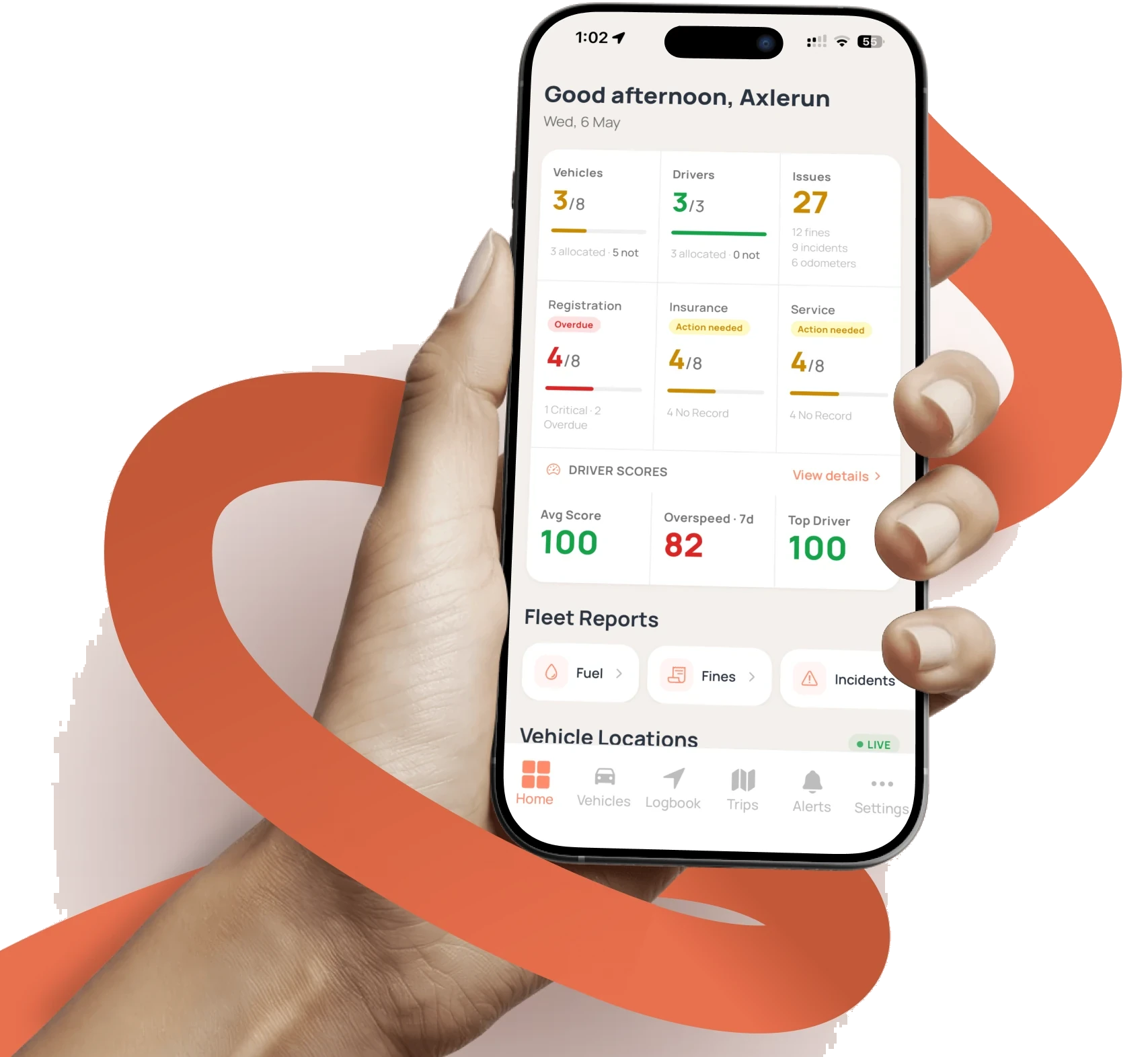
The faster way is to make the photo and the record the same step. In Axlerun, fuel records live against each vehicle, and any record can have the receipt photo or PDF attached, so the evidence and the figures stay together. On the Turbo plan, AI document scanning reads the litres, price and total off the photo into the fuel record, and you check and save it. It runs on iPhone and iPad today, with Android on the way.
Turbo is also where the advanced driver scoring and benchmarks sit, and the same scanner reads infringement notices. That helps when a camera fine arrives and you need to nominate the driver who had the ute.
Whatever you use, test it against one question before tax time. Could you hand your accountant every fuel expense for one ute for the year, each one with a readable picture of the original docket? If yes, the system works.
Frequently asked questions
Can I throw away paper fuel receipts after scanning them?
Generally, yes. The ATO accepts images of paper business records stored digitally, provided each copy is a true and clear reproduction of the original and meets its record-keeping rules. Once the image is saved you don't have to keep the paper, unless a particular law requires it. Check the photo is complete and readable before binning the docket.
Is a bank statement enough instead of a fuel receipt?
For employees claiming work-related expenses, the ATO says a bank or credit card statement on its own isn't written evidence, because it doesn't come from the supplier and usually lacks the required details. For business GST credits on purchases over $82.50 including GST, you need a tax invoice. Keep the receipt or invoice, and ask your accountant about any gaps.
Do I still need the receipt image if an app has read the figures?
Yes. The ATO says that if you enter details such as the supplier, date, amount and GST from a record into your accounting software, you still need to keep a copy of the actual record, either digitally or on paper. Extracted figures are a summary; the image is the evidence the figures came from.
How long should a business keep scanned vehicle receipts?
Most business records must be kept for five years. The ATO says the five years generally starts from when you prepared or obtained the record, or completed the transaction, whichever is later. FBT records run for five years from the date you lodge your FBT return. Some records must be kept longer.
Can my drivers all use the ATO app's myDeductions for fuel receipts?
Not as one shared record. The ATO says myDeductions should be used on a single device all year, because records can't be consolidated, and that multiple people can't use one device. Records are stored on the device and backups are not automatic. It suits a sole trader with simple affairs better than a business with several drivers.
Sources
- 1.Digital record keeping for businesses — Australian Taxation Office
- 2.Manual or paper record keeping for businesses — Australian Taxation Office
- 3.Overview of record-keeping rules for business — Australian Taxation Office
- 4.Keeping your business records safe and secure — Australian Taxation Office
- 5.When you can claim a GST credit — Australian Taxation Office
- 6.Tax invoices — Australian Taxation Office
- 7.Time limit on GST credits — Australian Taxation Office
- 8.Motor vehicle expenses (small business guide) — Australian Taxation Office
- 9.Logbook method — Australian Taxation Office
- 10.myDeductions — Australian Taxation Office
- 11.Records you need to keep — Australian Taxation Office
Axlerun is fleet software, not a tax agent. Rates and rules change — confirm anything that affects your return with your accountant or the ATO.
Fleet admin, minus the admin.
A short roundup a week — FBT, rego, fuel and fines — plus the occasional Axlerun update. No spam, unsubscribe any time.