An NDIS provider can claim a worker's travel time — up to 30 minutes each way in metro areas and 60 minutes in regional areas — plus non-labour running costs of up to $0.99 a kilometre for a provider- or worker-owned vehicle, where the participant has agreed to it in their Service Agreement.
Key takeaways
- The NDIS Pricing Arrangements and Price Limits 2025-26 treats up to $0.99 a kilometre as a reasonable contribution for provider travel in a vehicle owned by the provider or the worker.
- Travel time claims are capped at 30 minutes each way in MMM1-3 areas and 60 minutes each way in MMM4-5 areas, based on where the participant is when the support is delivered.
- Travel must be claimed as a separate line from the support itself, and the NDIA states that providers must keep accurate records of claims, which are subject to audit.
- The ATO's cents per kilometre rate is 91 cents for 2026-27, capped at 5,000 work-related kilometres per car per year.
- An ATO logbook must run for at least 12 continuous weeks and be retained for 5 years after the end of the latest income year it supports.
What can you actually claim when a worker drives to a participant?
Two things — and the NDIS treats them as two separate claims.
The first is the worker’s time behind the wheel: provider travel labour costs. The second is what the trip cost you to run — fuel, tolls, parking. That is provider travel non-labour costs, and it goes in against its own support item.
The NDIS Pricing Arrangements and Price Limits 2025-26 sets out what the NDIA considers a reasonable contribution towards the second bucket.
| What the kilometres are for | Reasonable contribution |
|---|---|
| Provider travel, vehicle owned by the provider or the worker | Up to $0.99 a kilometre |
| Tolls, parking, public transport fares | Up to the full amount |
| Transporting a participant, unmodified vehicle | Up to $0.99 a kilometre |
| Transporting a participant, modified vehicle or bus | Up to $2.76 a kilometre |
Those last two rows are a different rule. That is activity-based transport, where you are driving the participant somewhere rather than driving to them. Same odometer, different support item, different paperwork.
None of these figures are automatic. They are ceilings you negotiate under, and the participant has to agree in advance as part of their Service Agreement — not after the fact, once you know what the month looked like.

How much travel time can you claim?
Not all of it. The cap depends on where the participant is when the support is delivered, not where your office is. The NDIA classifies that location using the Modified Monash Model, running from MMM1 (major cities) to MMM7 (very remote).
- MMM1–3 — up to 30 minutes each way, per eligible worker, per participant
- MMM4–5 — up to 60 minutes each way
- MMM6–7 — no travel time limit, with remote and very remote loadings of 40% and 50%
Therapy providers sit under a tighter rule. Since 1 July 2025 they can claim half the relevant price limit for time spent travelling, still inside those caps. The NDIA’s own example: a physiotherapist with a price limit of $183.99 an hour can claim up to $92.00 an hour for travel time.
Travel time is claimed as a separate line from the support itself, at the same hourly rate you agreed for that support or lower. The non-labour costs are separate again.
Travel time and service time have to be shown separately on the invoice. Rolling travel into one blended hourly rate is not how the claiming rules are written.
One more trap worth knowing: if you have already claimed a support that has travel costs built into it, you cannot claim travel on top of it.
What has to sit behind $0.99 a kilometre?
A record you can reproduce months later. The pricing arrangements are blunt about this.

Claims have to accurately reflect what was delivered — the frequency, the volume, the type of support. A per-kilometre travel claim is an assertion about a drive that happened a long time before anyone asks about it. “Roughly twenty minutes across town” is not going to hold.
What does hold is dull and specific: the date, the participant, the purpose, the start and end points, and the distance. Captured at the time, not reconstructed at invoicing.
That distinction matters more than the format. The NDIA is not asking whether you use software. It is asking whether the number on the claim line can be traced back to a trip that actually happened.
What happens when one worker sees three participants in a morning?
You apportion. Where a worker travels to more than one participant on the same trip, both the travel time and the non-labour costs get divided between them — including the return leg, where that is claimable.
The division has to be agreed with each participant in advance, in their Service Agreement. You do not get to decide the split afterwards based on which plan has room left in it.
This is where small providers most often come unstuck. A three-participant morning is one continuous drive in the real world and three separate claim lines on paper, and the arithmetic has to be defensible for each participant on its own.
| Leg | Distance | Where it lands |
|---|---|---|
| Office → Participant A | 12 km | A's plan |
| Participant A → Participant B | 8 km | Apportioned by agreement |
| Participant B → Participant C | 15 km | Apportioned by agreement |
| Participant C → office | 20 km | Apportioned, where payable |
Why does the ATO want a different record from the same drive?
Because the NDIA and the ATO are asking different questions about the same kilometres.
The NDIA wants to know which participant a trip was for and whether the claim matches the support delivered. The ATO wants to know what proportion of that vehicle’s total use was business use, so it can work out what the business deducts. One is per participant. The other is per vehicle.
| Cents per kilometre | Logbook method | |
|---|---|---|
| Rate | 91c/km for 2026-27 | Actual expenses, apportioned by business use |
| Cap | 5,000 work-related km per car, per year | No cap |
| Records | How you worked out the kilometres, and that you own the car | 12 continuous weeks, odometer readings, purpose and destination of every journey |
| Receipts | Not required | Required for your car expenses |
The logbook rules are exacting. Twelve continuous weeks, broadly representative of your travel. Every work-related journey needs its reason and purpose, its destination, the odometer reading at each end, and the total kilometres. Each entry made at the end of the journey or as soon as possible afterwards.
A logbook is then valid for five years, and you have to retain it and your odometer records for five years after the end of the latest income year you rely on them. Business records follow a five-year rule too, generally running from when you made the record or completed the transaction, whichever is later.

Which method suits your vehicles depends on how far they actually run and what they cost you to keep on the road — that is a question for your accountant, not for us. If you want the mechanics, we covered running an ATO-ready logbook without a paper book, and what the ATO looks for in car claims goes through the substantiation side in more detail.
Which pricing document are you following this year?
Both of them, awkwardly. Open the NDIS pricing arrangements page today and you will find two separate things:
- The NDIS pricing schedule, effective 1 July 2026 — support item numbers, units and maximum prices
- The NDIS Pricing Arrangements and Price Limits 2025-26 — still the published rules document
So the price you charge comes from one document, and the rules about how you claim travel against it come from another, older one. The $0.99 and $2.76 figures above are from the 2025-26 arrangements, because that is where the travel rules still live.
If someone on your team is working from a single PDF they downloaded once, that is worth checking this week.
What does a kilometre record that survives an audit look like?
Five fields, captured on the day:
- 1Date and time of the trip
- 2Which participant it was for
- 3Purpose — the support being delivered
- 4Start and end locations
- 5Distance, plus odometer readings if you are running a logbook
A spreadsheet does this perfectly well, as long as someone actually fills it in the same day. The failure mode is almost never the format. It is a support worker reconstructing a fortnight of driving from memory on a Sunday night, and a per-kilometre claim nobody can stand behind six months later.
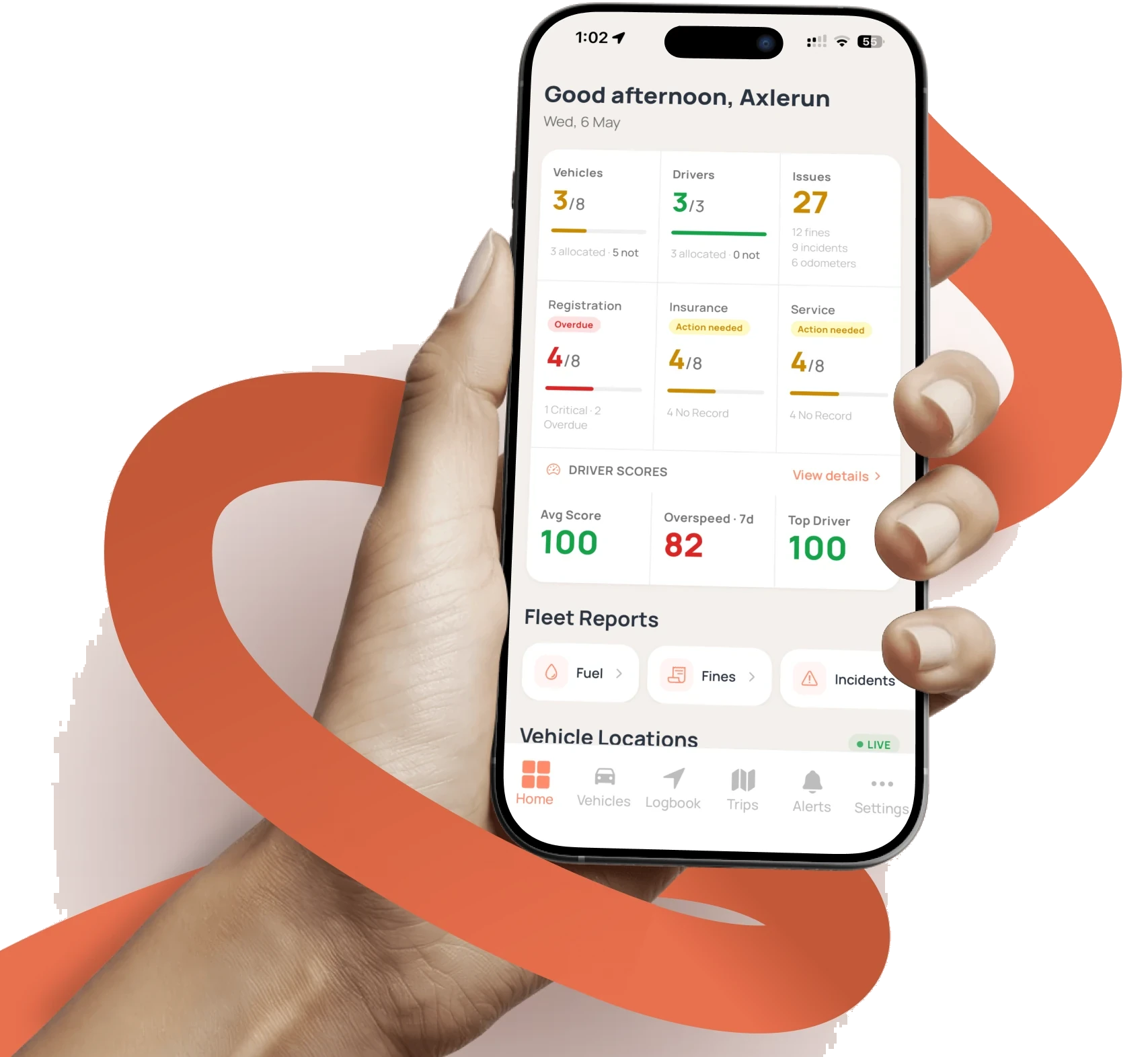
If that sounds like your Sunday nights, this is the part Axlerun takes off you: trips logged automatically by GPS with the odometer captured, an FBT logbook you can export as a PDF, and rego and compliance alerts across all eight states and territories. The first three vehicles are free forever, there is no hardware to fit, and your data exports whenever you want it.
Whatever you run it on, make the decision explicitly: which of your kilometres are NDIS claims, which are tax records, and how you capture both from the same trip, once, on the day it happens.
Frequently asked questions
Can NDIS providers charge for travel time?
Yes, where the claiming rules allow it and the participant has agreed. Providers can claim a worker’s travel time up to 30 minutes each way in MMM1-3 areas and 60 minutes each way in MMM4-5 areas. The claim goes in as a separate line from the support itself, at the hourly rate agreed for that support or lower.
How much can an NDIS provider claim per kilometre?
The NDIS Pricing Arrangements and Price Limits 2025-26 treats up to $0.99 a kilometre as a reasonable contribution for a vehicle owned by the provider or the worker. Tolls, parking and public transport fares can be passed on in full. For activity-based transport in a vehicle modified for accessibility, or a bus, the figure is up to $2.76 a kilometre.
Does travel have to be itemised separately on an NDIS invoice?
Yes. The NDIA states that travel time and service time must be shown separately on invoices, and that non-labour travel costs must be claimed separately again, against the relevant provider travel non-labour support item. Bundling travel into a single blended hourly rate for the support is not how the claiming rules are written.
What records back up an NDIS travel claim?
Enough detail to show the trip happened, who it was for and how far it ran. The NDIA requires providers to keep accurate records of claims and states that those records are subject to audit. In practice that means a date, a participant, a purpose and a kilometre figure you can reproduce months later.
Can the same kilometre records be used for my tax return?
The same trip data can feed both, but the two systems ask different questions. NDIS claims are per participant and per support item. An ATO logbook needs the reason, purpose, destination and odometer readings for every journey across 12 continuous weeks. Your accountant can advise which method suits your vehicles.
Which NDIS pricing document applies in 2026-27?
Both, in effect. The NDIS pricing schedule effective 1 July 2026 carries the prices. The claiming rules for provider travel — the time caps, the per-kilometre contributions and the separate-line requirement — still sit in the NDIS Pricing Arrangements and Price Limits 2025-26, published on the same page.
Sources
- 1.NDIS Pricing Arrangements and Price Limits 2025-26 (version 1.1) — National Disability Insurance Agency
- 2.Pricing arrangements — National Disability Insurance Agency
- 3.Travel claiming rules, gap fees and other costs — National Disability Insurance Agency
- 4.Cents per kilometre method — Australian Taxation Office
- 5.Logbook method — Australian Taxation Office
- 6.Overview of record-keeping rules for business — Australian Taxation Office
Axlerun is fleet software, not a tax agent. Rates and rules change — confirm anything that affects your return with your accountant or the ATO.
Fleet admin, minus the admin.
A short roundup a week — FBT, rego, fuel and fines — plus the occasional Axlerun update. No spam, unsubscribe any time.