Yes, the ATO accepts a digital logbook. Its guidance lists "an electronic or pre-printed logbook" as acceptable records. What matters is content, not format: every journey needs its date, odometer readings at both ends, kilometres travelled and reason, kept for 12 continuous weeks.
Key takeaways
- The ATO names "an electronic or pre-printed logbook" as acceptable records — digital is not a workaround.
- Every journey needs a reason, start and end date, odometer readings at both ends, and kilometres travelled.
- The first logbook must run at least 12 continuous weeks and be representative of your travel across the year.
- Each logbook stays valid for five years, but you must keep maintaining odometer readings in the years after.
- Without logbook and odometer records you must use the FBT statutory formula method, which ignores actual business use entirely.
You do not need a glovebox notebook to satisfy the ATO. What you need is a record that contains everything the ATO asks for, kept over the right period, and still findable in five years. The format is your choice — the ATO’s own guidance names “an electronic or pre-printed logbook” as acceptable records for the logbook method.
That distinction matters, because the paper book is not the requirement. It is just the most common way people fail the requirement.
What does the ATO actually require in a logbook?
The requirements are specific, and they are the reason so many logbooks fall over. Your logbook must record:
- when the logbook period begins and ends
- the car’s odometer readings at the start and end of the period
- the total kilometres the car travelled during the period
- the kilometres travelled for each journey
- the odometer readings at the start and end of each later income year the logbook covers
- the business-use percentage for the period
- the car’s make, model, engine capacity and registration number
Then, for every single journey, you need the reason for the trip, the start and end date, the odometer readings at both ends, and the kilometres travelled. If you make two or more trips in a row on the same day, the ATO lets you record them as one journey.
Read that list again and notice what it demands: odometer readings at both ends of every trip. Not an estimate at the end of the week. Not “about 40k to the Northcote job”. That is the detail that quietly decides whether a logbook holds up, and it is almost impossible to reconstruct on a Sunday night.

Does the ATO accept an app instead of a paper book?
Yes. The records you need to keep are listed as “an electronic or pre-printed logbook”, plus evidence of your fuel and oil costs (or the odometer readings you estimate them from) and evidence of your other car expenses. The ATO also runs its own electronic option: sole traders with simple tax affairs can record business trips using the myDeductions tool in the ATO app.
So the question is not whether digital is allowed. It is whether whatever you use captures every field in the list above, for every trip, without relying on you to remember.
What happens if you don’t keep one?
This is the part most small businesses find out too late, and it is worth being precise about.
If you provide a vehicle to an employee, you work out the taxable value of that car fringe benefit using either the statutory formula method or the operating cost method. The ATO is blunt about the condition: to use the operating cost method you must have adequate records to determine the car costs, logbook records and odometer records. If you don’t have these records, you must use the statutory formula method.
Under the statutory formula, the taxable value is the car’s base value multiplied by a statutory percentage — 20% for arrangements entered into from 31 March 2015 — multiplied by the days the car was available for private use, divided by the days in the FBT year, less any employee contribution.

Notice what is missing from that calculation: how much the vehicle was actually used for business. A ute that ran 90% business kilometres is treated exactly the same as one that sat at a house all year. Without logbook records you cannot demonstrate the difference, so you do not get to claim it.
That is the real cost of the missing notebook. Not a penalty — a method you are locked out of.
How do the three approaches actually compare?
| Approach | What it takes | Where it breaks |
|---|---|---|
| Paper logbook | A book in each vehicle, filled in at the time, for 12 continuous weeks | Drivers forget mid-job; odometer readings get estimated later; the book lives in a vehicle that changes hands |
| Spreadsheet | Someone entering trips from memory or from job records each week | Odometer readings are reconstructed rather than recorded; gaps appear in busy weeks; version lives on one laptop |
| Automatic capture | Trips recorded in the background, classified afterwards | You still have to review and classify honestly; it does not decide your tax position for you |
How long does a logbook last once you’ve done it?
Longer than most people expect, which is the argument for doing it properly once. If it is your first year using the logbook method, you keep a logbook for at least 12 continuous weeks during the income year, and that 12-week period has to be representative of your travel across the year. Each logbook is then valid for five years, though you can start a new one whenever you like.
Two catches. If your circumstances change — a change in the type of work your business does, for instance — you may need a new logbook before the five years is up. And if you are leaning on a logbook from an earlier year, you must keep that logbook and keep maintaining odometer readings in the years that follow.
The five-year clock does not mean five years of doing nothing.
For FBT, the shape is the same: logbook records are usually maintained for a continuous 12-week period, odometer records cover the same 12 weeks plus the total distance travelled each year, and the period you choose should be representative of the car’s business use.
Running more than one vehicle adds one more rule worth knowing before you start: if you use the logbook method for two or more cars, each car’s logbook has to cover the same period. You cannot do the ute in March and the van in September.
When is a paper logbook still completely fine?
Often, and it is worth saying so plainly.
One vehicle, one driver, predictable work, and an owner who will genuinely write down the odometer at both ends of every trip for twelve weeks — that person does not need software. They need twelve weeks of discipline once every five years. A book from the newsagent will do the job.

The cents per kilometre method is also worth knowing about if your business travel is light. It uses a set rate per kilometre, caps out at 5,000 business kilometres per car per year, and does not require written evidence of exactly how many kilometres you travelled — though the ATO may still ask you to show how you worked the figure out. It is only available to sole traders and partnerships claiming for a car. Check the current rate on the ATO’s cents per kilometre page, because it changes between income years.
Paper stops working at the point where the vehicle stops having one driver. A ute that three people use across a fortnight has no single person responsible for the book, and the odometer readings are the first thing to go.
What does the faster version look like?
The failure mode is always the same: nobody writes the trip down at the time. Every other problem — missing odometer readings, gaps in the twelve weeks, kilometres reconstructed from job sheets — follows from that one.
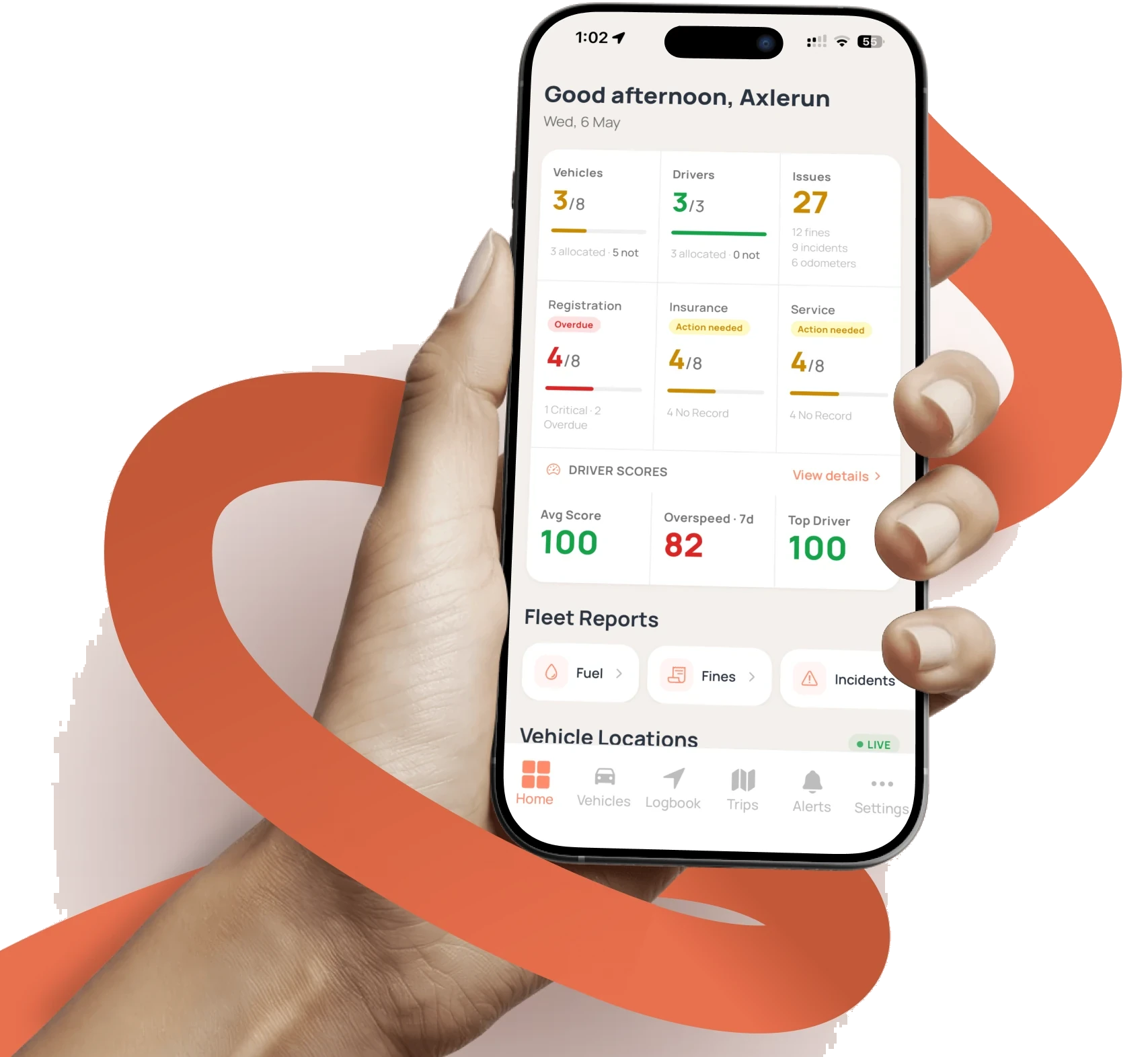
So the fix is to stop relying on anyone remembering. Axlerun records trips automatically in the background on the Cruise plan, capturing the route, distance, odometer and time as they happen. You classify them as business or private afterwards, in bulk, and export an FBT logbook PDF in one tap to hand to your accountant. On the free Drive plan — the first three vehicles, forever — you log trips manually and still get the PDF export.
What it will not do is tell you which FBT method suits your business, or whether a particular trip is genuinely business use. Those are calls for you and your accountant. The software’s job is narrower and more useful: make sure that when you make those calls, you are working from a complete record instead of a reconstruction.
If you want to see how the logbook and compliance features work across the plans, the features and pricing page breaks it down. If you have a specific question about your setup, get in touch — we would rather point you at the right ATO page than sell you something you do not need.
Frequently asked questions
Does the ATO accept a digital or app-based logbook?
Yes. The ATO lists "an electronic or pre-printed logbook" among the records you need to keep for the logbook method, and it offers its own electronic option through the myDeductions tool in the ATO app for sole traders with simple tax affairs. The format is not the issue — whether every required field is captured for every trip is.
How long does an ATO logbook need to run?
In your first year using the logbook method, at least 12 continuous weeks during the income year. That period has to be representative of your travel across the whole year, so choosing an unusually quiet or unusually busy stretch defeats the purpose. For FBT, logbook records are usually maintained over a continuous 12-week period too.
How long is a logbook valid once I have completed it?
Each logbook is valid for five years, and you can start a new one at any time. Two conditions apply: if your circumstances change, such as a change in the type of work your business does, you may need a new logbook sooner. And if you rely on an earlier year’s logbook you must keep it and continue maintaining odometer readings each year.
What happens at FBT time if I have no logbook?
You lose access to the operating cost method. The ATO requires adequate records of car costs, logbook records and odometer records to use it, and states that without those records you must use the statutory formula method instead. That method applies a statutory percentage to the car’s base value and takes no account of how much the vehicle was actually used for business.
Can I keep one logbook covering several vehicles?
No, each car needs its own logbook, but if you use the logbook method for two or more cars, the logbook for each car must cover the same period. You cannot run the ute’s 12 weeks in autumn and the van’s in spring. Pick one 12-week window that is representative of business use across all of them.
What has to be recorded for each individual trip?
The reason for the journey, the start and end date, the odometer readings at the start and end, and the kilometres travelled. If you make two or more journeys in a row on the same day, the ATO allows you to record them as a single journey. The odometer readings are the field most often estimated after the fact, and the one hardest to defend.
Sources
- 1.Logbook method — Australian Taxation Office
- 2.Taxable value of a car fringe benefit — Australian Taxation Office
- 3.Fringe benefits tax – a guide for employers — Australian Taxation Office
- 4.Cents per kilometre method — Australian Taxation Office
Axlerun is fleet software, not a tax agent. Rates and rules change — confirm anything that affects your return with your accountant or the ATO.
Fleet admin, minus the admin.
A short roundup a week — FBT, rego, fuel and fines — plus the occasional Axlerun update. No spam, unsubscribe any time.