This tax time the ATO is scrutinising work-related car claims and has emailed about 500,000 taxpayers. To claim, keep records that prove business use: a diary of how you worked out your kilometres for the cents-per-kilometre method, or a 12-week logbook and receipts for the logbook method.
Key takeaways
- For the 2025–26 return you are lodging now, the ATO cents-per-kilometre rate is 88 cents, capped at 5,000 work-related kilometres per car — a maximum claim of $4,400.
- From 1 July 2026 the cents-per-kilometre rate rises to 91 cents (an 89-cent base plus a one-off 2-cent uplift), lifting the per-car cap to $4,550.
- The ATO has told around 500,000 taxpayers it is watching car claims, and flags claiming the full 5,000 km every year with no records as a red flag.
- Cents-per-kilometre needs no receipts but does need a record of how you worked out your kilometres; the logbook method needs 12 continuous weeks of entries and stays valid for 5 years.
- Sole traders and partnerships can use cents-per-kilometre or a logbook for a car; companies and trusts can only claim actual running costs and must keep records for 5 years.
What did the ATO actually say about car claims?
Work-related car expenses are one of the ATO’s headline targets this tax time. In early July it sent a genuine “nudge” to around 500,000 taxpayers, asking them to check their car claims before lodging, and saying it is watching the area more closely than ever where it thinks claims are incorrect or excessive.
That sits inside the ATO’s broader focus for the 2026 tax time: work-related deductions and expenses, and omitted income. The rules themselves have not changed — the level of attention has. If you run utes or vans and put motor vehicle costs through the business, this is the year to make sure the paperwork behind every claim actually exists.
The ATO’s line on deductions is worth pinning to the office wall:
“You must have spent the money yourself and not have been reimbursed… and you have to be able to support your claim with records such as a receipt, invoice or logbook.” — Australian Taxation Office
Did the cents-per-kilometre rate change?
Yes — but not for the return you are lodging right now. For the 2025–26 income year, the cents-per-kilometre rate is 88 cents. You can claim up to 5,000 work-related kilometres per car under this method, so the most a single car can return is $4,400.
From 1 July 2026 the rate steps up to 91 cents per kilometre for the 2026–27 year. The ATO describes that as an 89-cent base rate plus a one-off 2-cent uplift for the year. At 91 cents, the same 5,000 km cap works out to a maximum of $4,550 per car.

So the trips you take from now on are worth a little more per kilometre. The cap, and the need to prove the kilometres, are exactly the same as before.
What can your business actually claim for its vehicles?
How you claim depends on your business structure, so it is worth being clear before you start. Getting this wrong is one of the easiest ways to land in the ATO’s review pile.
If you operate as a sole trader or a partnership with at least one individual partner, and the vehicle is a car, you can use either the cents-per-kilometre method or the logbook method — whichever gives the better result, as long as you can back it up.
If you run the business through a company or a trust, the ATO only lets you claim the actual costs of running the vehicle for business — fuel, servicing, registration, insurance and the like — and you must keep those records for five years. The per-kilometre and logbook methods are for individuals, not companies.
Private use is never deductible, whichever structure you use — and that starts with the daily commute.
Trips the ATO treats as private include:
- Home to your regular work base and back — the daily commute
- Personal errands or the school run in a work vehicle
- Any trip you were separately reimbursed for
Cents per kilometre or logbook — which should you keep?
The two methods trade simplicity for the size of the claim. Cents-per-kilometre is the light-touch option: you claim a set rate for each work kilometre, up to 5,000 km, and you do not need fuel receipts. You do need a record of how you worked out those kilometres — a diary or a running log — and you need to be able to show you own the car.
The logbook method usually gives a bigger deduction if you drive a lot for work, but it asks more of you. You keep a logbook for at least 12 continuous weeks that is representative of your normal driving, then apply the business-use percentage it produces to your actual running costs.
| Feature | Cents per kilometre | Logbook method |
|---|---|---|
| Who can use it | Sole traders, partnerships (cars) | Sole traders, partnerships (cars) |
| Basis of claim | 88c per km, 2025–26 | Business-use % of actual costs |
| Cap | 5,000 work km per car | No kilometre cap |
| Receipts | Not required | Required |
| Key record | Diary of how km were worked out | 12-week logbook + odometer |

Whichever you pick, the ATO can ask you to show your working. The method is your choice; the evidence behind it is not optional.
Why is claiming the full 5,000 km a red flag?
Because a lot of people treat the 5,000 km cap as a number they are simply allowed to write down. It is not. It is a maximum you can claim if you can substantiate the kilometres — and the ATO has singled out taxpayers who claim the full amount year after year with nothing to show how they got there.
The fix is not to claim less than you are entitled to. It is to hold the record that supports whatever you do claim. A short diary noting the date, reason and distance of each work trip is enough for the cents-per-kilometre method. Reconstructing it from memory the night before you lodge is exactly what the ATO is trained to spot.
If you think a past claim was too high, the ATO’s position is that you should amend it. What your own situation calls for is a question for your accountant — this is general information, not advice about your return.

What records does the ATO actually want to see?
The standard is easy to state and easy to fall short of: keep records that prove the expense was real, was yours, and was for business — and keep them for five years. For motor vehicles that usually means:
- A logbook covering at least 12 continuous weeks, with the date, reason and destination of each work trip
- Odometer readings at the start and end of each journey, and for the start and end of the logbook period
- Receipts or invoices for fuel, servicing, registration and insurance if you use the logbook or actual-cost method
- A diary or app record of how you calculated your kilometres if you use cents-per-kilometre
A logbook, once done properly, stays valid for five years — you do not have to start again every July unless your driving pattern changes. Keeping it as you go, rather than in a scramble at tax time, is the whole game. Our blog has a full walk-through of what a compliant, paper-free logbook entry looks like.
How Axlerun keeps it on file for you
None of this needs special software. A notebook in the glovebox and a tidy folder of receipts will satisfy the ATO, as long as you keep them up to date. The reason most claims fall apart is not the method — it is the six months of trips nobody wrote down.
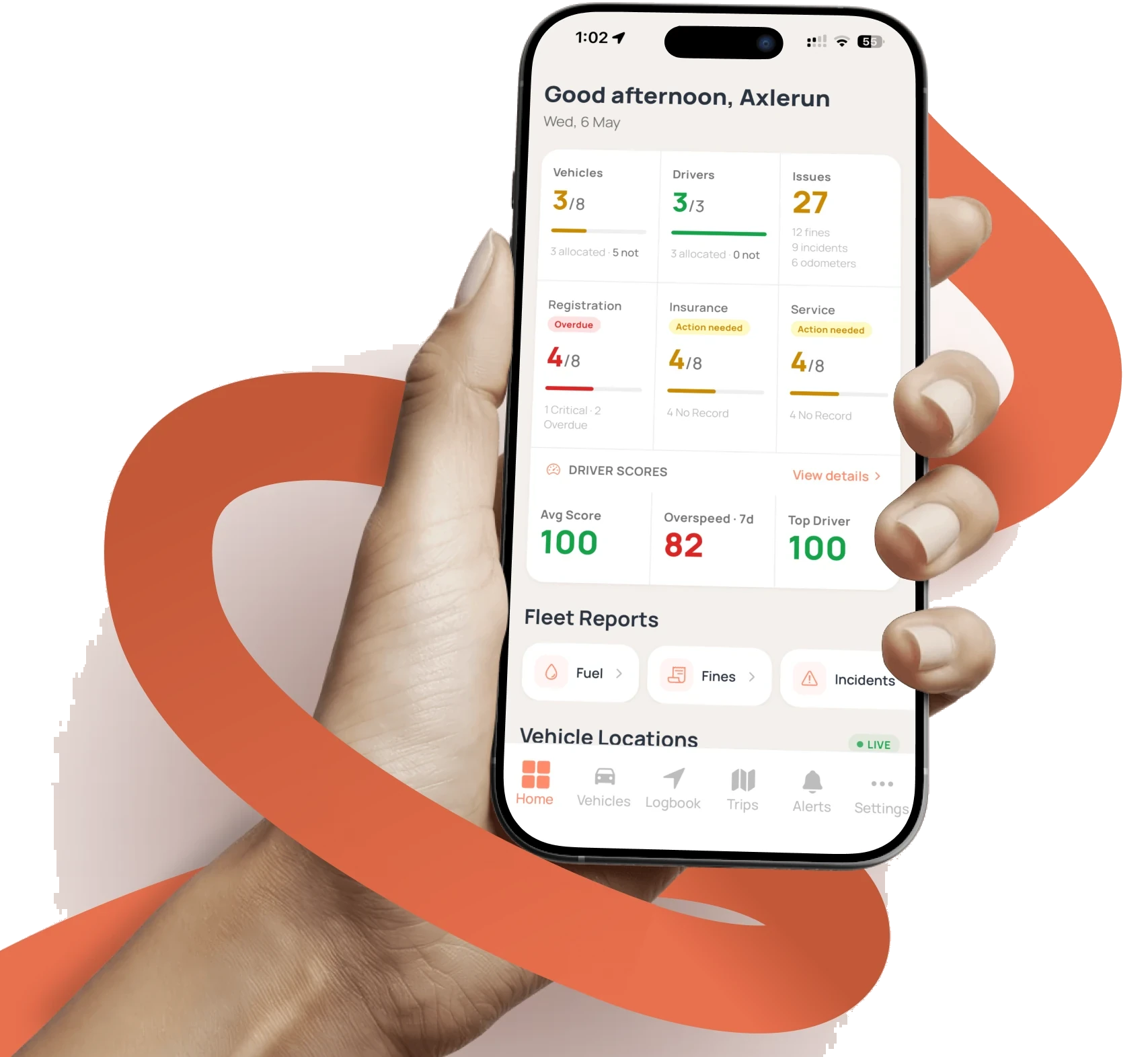
That is the gap Axlerun is built to close. Manual trip logging, fuel records with receipt capture, and an FBT logbook PDF you can export are all on the free Drive plan — the first three vehicles are free forever, with no hardware and no lock-in contract. Step up to Cruise and the logbook fills itself in from GPS, so the 12 weeks happen without anyone remembering to press start.
If you want to sanity-check whether your current records would survive a review, get in touch — and take anything specific to your own tax position to your accountant.
Frequently asked questions
What is the ATO cents-per-kilometre rate for 2026?
For the 2025–26 income year — the return most people are lodging now — the rate is 88 cents per work-related kilometre, capped at 5,000 km per car. From 1 July 2026 it rises to 91 cents for the 2026–27 year, made up of an 89-cent base rate plus a one-off 2-cent uplift.
Do I need receipts to claim car expenses?
It depends on the method. Under the cents-per-kilometre method you do not need fuel receipts, but you must keep a record showing how you worked out your work kilometres. Under the logbook or actual-cost method you do need receipts for fuel, servicing, registration and insurance, kept for five years.
Can my business claim the trip between home and work?
No. The ATO treats travel between your home and your regular place of work as private, even in a signwritten work ute, and says misclassified home-to-work travel is one of the things it is watching this tax time. Trips between job sites may be deductible — check your own situation with your accountant.
How long does an ATO logbook last?
A logbook is valid for five years once you have kept it for at least 12 continuous weeks. You do not need to redo it every year unless your work-related driving pattern changes — for example if you change roles or move house. You still record odometer readings each year and keep receipts for your running costs.
Why did the ATO email me about my car claim?
In early July 2026 the ATO sent a genuine nudge to around 500,000 taxpayers, asking them to check their work-related car claims before lodging. It is not a scam or an audit notice. The ATO has said it is focusing on people who claim the full 5,000 km cap without records to back it up.
Sources
- 1.Cents per kilometre method — Australian Taxation Office
- 2.Cents per Kilometre Deduction Rate for Car Expenses 2026 Determination — ATO Software Developers
- 3.Logbook method — Australian Taxation Office
- 4.Motor vehicle expenses — small business tax time toolkit — Australian Taxation Office
- 5.From 'hacks' to half-truths: ATO warns of tax time misinformation and reveals focus areas — Australian Taxation Office
- 6.ATO crackdown targets Australian drivers claiming work-related car expenses this tax return season — The Nightly
Axlerun is fleet software, not a tax agent. Rates and rules change — confirm anything that affects your return with your accountant or the ATO.
Fleet admin, minus the admin.
A short roundup a week — FBT, rego, fuel and fines — plus the occasional Axlerun update. No spam, unsubscribe any time.