An Australian HVAC van carries three sets of records. The business's Refrigerant Trading Authorisation requires quarterly records of refrigerant bought, sold and recovered, plus quarterly cylinder leak checks. Parts supplied on jobs can be ATO trading stock, valued each year. The van needs rego, service and, for FBT, private-use evidence.
Key takeaways
- A Refrigerant Trading Authorisation requires quarterly records of refrigerant bought, recovered, sold and disposed of, and a leak check of every container at least each quarter.
- The ARC's permit condition check asks for the last two quarters of records, but not the amount charged into each customer's system.
- R32 is a Dangerous Goods Class 2.1 flammable gas, while R410A, R134a and R22 are Class 2.2 non-flammable gases.
- Under the ATO's simplified trading stock rules, no formal stocktake is needed if you reasonably estimate stock value changed by $5,000 or less in the year.
- A van designed to carry 1 tonne or more, or under 1 tonne but not mainly for passengers, can be exempt from FBT where private use is limited.
An HVAC van is a mobile store. It holds gas you are licensed to possess, stock you will bill to customers, and the vehicle itself. Each of those comes with records, and each set gets checked by a different authority.
Most van-setup guides online are American. They cite DOT and OSHA, quote weights in pounds and say nothing about who checks a van in Australia. This one covers the Australian rules.
Which records ride along in an HVAC van?
There are three sets, and they run on three different clocks.
| What is in the van | Who asks about it | How often you record it |
|---|---|---|
| Refrigerant cylinders | Australian Refrigeration Council (ARC) | Every quarter |
| Parts and materials you supply on jobs | Australian Taxation Office (ATO) | Every income year |
| The van itself | ATO for FBT; your state for rego | Ongoing, per vehicle |
The refrigerant records are the ones most small operators fall behind on. The records are not hard to keep. Nobody asks for them until the ARC books a permit condition check, and by then you are rebuilding two quarters from memory.
What does the ARC want to know about the gas in your van?
Two permits are involved. A Refrigerant Handling Licence (RHL) belongs to the technician. A Refrigerant Trading Authorisation (RTA) belongs to the business. The RTA is what lets the business acquire, store and dispose of refrigerant. Every cylinder in every van sits under it.
The conditions come from Regulation 141 of the Ozone Protection and Synthetic Greenhouse Gas Management Regulations 1995. As the holder, you must:
- keep up-to-date records of refrigerant bought, recovered, sold and otherwise disposed of, each quarter
- check every refrigerant container in your possession for leaks at least every quarter
- put a risk management plan into effect for handling and storing refrigerant
- use only refillable containers for storage
- make sure only appropriately licensed people handle the refrigerant, and record each one’s name and licence number every quarter
- record the dates your cylinders were tested
- show your RTA number on advertising, invoices, receipts and quotes
The ARC says every RTA holder will get a permit condition check. You will be asked for the last two quarters of purchase, bulk sale and recovery records, plus cylinder leak and test dates, equipment maintenance records, your staff licence details and evidence of the risk management plan.

One detail catches people out. The ARC does not want the amount charged into each customer’s system; that is not a recording requirement. It wants bulk figures: what you bought, what you sold as whole cylinders, and what you returned for destruction. The ARC also says supplier invoices cannot stand in for your purchase record.
What changes when the cylinder in the back is R32?
R32 is a flammable gas. The ARC’s R32 guidance says it is classified as a Dangerous Goods Class 2.1 flammable gas under the Australian Dangerous Goods Code. It needs more handling and storage safeguards than Class 2.2 non-flammable gases such as R410A.
The 2025 Refrigerant Handling Code of Practice (Part 2) lists examples in each division:
| Refrigerant | ADG Code division | What it means for the van |
|---|---|---|
| R32 | 2.1 flammable | Mark cylinders with the red-diamond Flammable Gas 2.1 label; keep away from ignition sources |
| R410A | 2.2 non-flammable, non-toxic | Standard cylinder care still applies |
| R134a | 2.2 non-flammable, non-toxic | Standard cylinder care still applies |
| R404A and R407A | 2.2 non-flammable, non-toxic | Standard cylinder care still applies |
| R22 | 2.2 non-flammable, non-toxic | Standard cylinder care still applies |
The same Code says cylinders must be leak tested every 3 months, gauges should come off the cylinder for storage and transport, and a cylinder not in use must have its valve closed, the outlet cap on and the valve protected. For vehicle storage it points to the AIRAH Flammable Refrigerants Safety Guide, which includes a self-assessment tool for vehicle storage.
The ARC also says employers have a duty of care to make sure workers are trained and equipped for A2L refrigerants like R32. State WorkSafe regulators set the workplace safety rules on top of that, so check with yours.
Is the stock in your van trading stock?
Often, yes. The ATO defines trading stock as anything your business acquires, produces or manufactures for the purpose of manufacturing, selling or exchanging. Fittings, line sets and parts that go into a customer’s install and onto their invoice can fit that description.
The ATO excludes some things. Spare parts held to repair your own plant and equipment are not trading stock. Neither are consumables used in manufacturing trading stock. Where the line falls for your business is a question for your accountant.
Every business with trading stock has to account for its value at the end of each income year. The ATO offers a shortcut, and its own worked example is a tradie with stock in his van.
The ATO’s example: an electrician valued the stock in his van and workshop at $6,800 at the end of the previous year. He estimated closing stock at $7,820. The difference was under $5,000, so he did not need a stocktake.
Under the simplified trading stock rules, if you reasonably estimate that the value of your stock changed by $5,000 or less over the year, you don’t have to do a formal stocktake. You also don’t have to account for the change. The rules are open to small businesses with aggregated turnover under $10 million. For income years starting on or after 1 July 2021, they are also open to businesses with turnover of $10 million or more but under $50 million.

If the value moved by more than $5,000, the general trading stock rules apply. An increase becomes assessable income and a decrease is a deduction. The ATO’s second example shows the difference. Opening stock of $5,600 and a closing estimate of $8,000 needs no stocktake. A closing estimate of $12,000 does.
Does a stock estimate mean counting every van?
Not necessarily. It does mean the estimate has to stand up. The ATO says it must be made in good faith, follow a rational process, and be something you can explain and prove if asked. The ATO lists what to consider, including:
- the type of stock you hold, such as a large range with few of each item
- where your stock is stored, for example one location or several
- how you value it, whether at cost, market selling value or replacement value
- how accurate your purchase and sales records are
- your inventory system and any stocktakes you have done
For an HVAC business, “several locations” usually means every van plus the shed. A rough per-van list, updated when a van is restocked, makes the 30 June estimate much easier to defend than a guess made in July.
Is your van a “car” in the ATO’s eyes?
This matters for fringe benefits tax if employees take vans home. The ATO says an employee’s limited private use of an eligible vehicle can be exempt from FBT. Eligible vehicles include those designed to carry a load of 1 tonne or more, and those designed to carry less than 1 tonne but not principally to carry passengers.
The ATO works out load capacity as gross vehicle weight minus basic kerb weight. The gross vehicle weight is usually on the compliance plate. It is a design figure. What is racked in the back on a given day does not change it.
“Limited” private use means travel incidental to travel in the course of the employee’s duties, plus non-work use that is minor, infrequent and irregular, such as an occasional run to the tip. The ATO says you don’t need special records to claim the exemption. You do have to be able to show the use met the conditions, for example by regularly comparing odometer readings with the distance you would expect between home and work. There is more on how this works in when a work ute is actually exempt from FBT.

The van’s own paperwork sits alongside that: rego and CTP renewal dates, service intervals, insurance, tolls and fines. None of it is complicated. It is just easy to lose track of across four or five vans.
How do you keep all three without a filing cabinet?
Split the work by how often it comes up.
| When | Refrigerant (ARC) | Stock (ATO) | Vehicle |
|---|---|---|---|
| Every quarter | Purchases, bulk sales, recovery returns; cylinder leak checks; licence holder list | Nothing required | Odometer readings if you rely on the FBT exemption |
| On restock | Nothing extra | Update the per-van stock list | Nothing extra |
| 30 June | Nothing extra | Estimate opening vs closing value | Nothing extra |
| As due | Cylinder test dates | Nothing extra | Rego, CTP, service, insurance |
For the refrigerant side, the ARC publishes a quarterly reporting spreadsheet and a guide to writing the risk management plan. You don’t have to use its templates, but you do have to keep the records each quarter, and a spreadsheet is a sensible home for them.
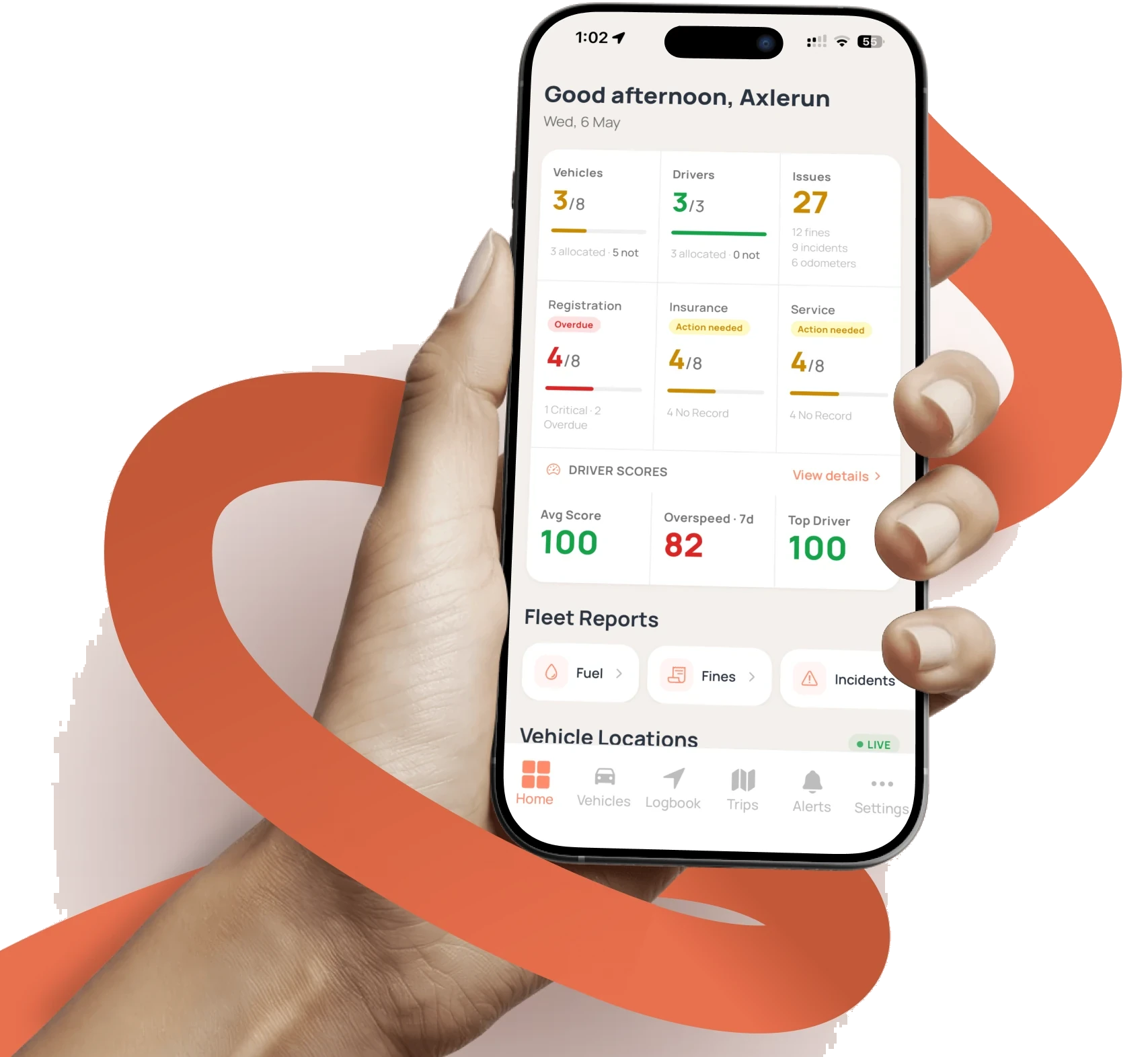
The vehicle side is where Axlerun fits. Each van gets a profile with its rego, service, insurance and odometer records, and on the free Drive plan the first three vehicles cost nothing, with no hardware and no lock-in. If you want to be warned before a rego or service falls due, those alerts are on the Cruise plan. See how it works for HVAC businesses running vans.
None of this is tax advice. The ARC and the ATO set the rules; your accountant can tell you how they apply to your business.
Frequently asked questions
Does a sole trader air conditioning technician need a Refrigerant Trading Authorisation?
If the business acquires, stores or disposes of refrigerant, yes. The Australian Refrigeration Council says an RTA allows businesses or sole traders to acquire, store and dispose of refrigerants, while a Refrigerant Handling Licence is for the individual doing the work. A sole trader holding gas in their van typically needs both. Check your situation with the ARC.
How often do refrigerant cylinders in a van have to be leak checked?
RTA holders must check every refrigerant container in their possession for leaks at least every quarter, under Regulation 141 of the Ozone Protection and Synthetic Greenhouse Gas Management Regulations 1995. The 2025 Refrigerant Handling Code of Practice also says cylinders must be leak tested every 3 months, and the result goes in your quarterly records.
Is R32 a dangerous good when carried in a work van?
Yes. The Australian Refrigeration Council classifies R32 as a Dangerous Goods Class 2.1 flammable gas under the Australian Dangerous Goods Code. The 2025 Code of Practice says cylinders for transport should carry the red-diamond Flammable Gas 2.1 label. It points to the AIRAH Flammable Refrigerants Safety Guide, which includes a self-assessment tool for storing cylinders in vehicles.
Do I have to do a stocktake of every van at 30 June?
Not always. Under the ATO's simplified trading stock rules, eligible businesses whose stock value changed by $5,000 or less during the year, on a reasonable estimate, don't need a formal stocktake. The estimate must be made in good faith and you must be able to explain it. Your accountant can confirm whether the rules apply to you.
What records does the ARC check at a permit condition check?
The ARC asks for the last two quarters of refrigerant bought, sold in bulk and recovered for destruction. It also checks equipment details and maintenance, cylinder leak test and test dates, staff licence details, evidence of a risk management plan, and whether your RTA number appears on advertising and invoices. Amounts charged into customers' systems are not required.
Sources
- 1.What is the difference between a Refrigerant Trading Authorisation and a Refrigerant Handling Licence? — Australian Refrigeration Council
- 2.Conditions of Authorisation — Australian Refrigeration Council
- 3.Business Reporting Templates and Guides — Australian Refrigeration Council
- 4.Prepare for a Permit Condition Check (Audit) — Australian Refrigeration Council
- 5.R32 Refrigerant information for technicians — Australian Refrigeration Council
- 6.Australia and New Zealand Refrigerant Handling Code of Practice 2025, Part 2 — Australian Refrigeration Council
- 7.Accounting for business trading stock — Australian Taxation Office
- 8.Simplified trading stock rules — Australian Taxation Office
- 9.Exempt use of eligible vehicles — Australian Taxation Office
Axlerun is fleet software, not a tax agent. Rates and rules change — confirm anything that affects your return with your accountant or the ATO.
Fleet admin, minus the admin.
A short roundup a week — FBT, rego, fuel and fines — plus the occasional Axlerun update. No spam, unsubscribe any time.