Melbourne tolls a tradie's ute or van as a light commercial vehicle if it has cab chassis construction and a gross vehicle mass above 1.5 tonnes — 60% more than a car. From 1 July 2026 the CityLink trip cap is $20.23 for an LCV against $12.64 for a car, and EastLink's is $12.88 against $8.05.
Key takeaways
- A light commercial vehicle pays 60% more than a car on CityLink, EastLink and the West Gate Tunnel alike.
- Linkt classes a vehicle as an LCV on construction and gross vehicle mass — cab chassis, two axles, over 1.5 tonnes GVM — not on whether it is used for work.
- The West Gate Tunnel charges an LCV $10.80 instead of $6.75 to exit into the city between 7am and 9am on weekdays.
- Linkt has confirmed some Victorian vehicles were incorrectly classified on CityLink and the West Gate Tunnel, and is refunding the overcharges.
- The ATO allows a deduction for tolls incurred for work-related vehicle use, but not for tolls between home and a regular workplace.
Why does a van pay more than a wagon on the same road?
Melbourne prices tolls by vehicle class, and class is decided by the shape of the vehicle, not the work it does. Linkt sets out four classes for Victoria. The one most electrical contractors land in is the light commercial vehicle.
Light commercial vehicle (LCV): any two-axle rigid vehicle with a cab chassis construction, with a gross vehicle mass greater than 1.5 tonnes but less than or equal to 4.5 tonnes, excluding buses seating more than 12 people.
A “car” is then defined by exclusion — anything that is not a motorcycle, an LCV, a heavy commercial vehicle or a long heavy commercial vehicle. That is how a large 4WD wagon can sit in the car class while a lighter cab-chassis ute sits in LCV and pays more on the same stretch of road.
Two details catch people out. Linkt says a Victorian vehicle class applies whether the vehicle is used for personal or commercial use, so the Saturday trip to Bunnings is charged at the work rate. And class does not change when you tow — a trailer of cable drums behind the ute does not move it up a class, and a caravan does not move a car up either.
What do Melbourne’s toll roads charge a van in 2026?
Every Melbourne toll road publishes a cap: the most you can be charged for one uninterrupted trip. Here is what an account holder pays at the cap right now, car against LCV.
| Road | Car | LCV | Applies |
|---|---|---|---|
| CityLink trip cap | $12.64 | $20.23 | 1 Jul – 30 Sep 2026 |
| EastLink toll cap (normal trip) | $8.05 | $12.88 | 1 Jul 2026 – 30 Jun 2027 |
| West Gate Tunnel toll point | $4.22 | $6.75 | Quarter ending 30 Sep 2026 |
| West Gate Tunnel, inbound 7–9am city exits | $6.75 | $10.80 | Quarter ending 30 Sep 2026 |
The ratio is the same everywhere: an LCV pays exactly 60% more than a car. That is not a rounding artefact of one operator’s pricing — it holds across CityLink, EastLink and the West Gate Tunnel.

One more line worth knowing. EastLink publishes a discounted cap of $6.45 for cars on weekends and public holidays. There is no equivalent discount in the LCV column — the LCV cap stays at $12.88 whatever day you drive.
What does the 7–9am West Gate Tunnel toll do to a morning start?
The West Gate Tunnel adds a charge most tradies will meet before their first job. Inbound vehicles using the City West exits — Footscray Road, Wurundjeri Way or Dynon Road — between 7am and 9am on weekdays pay a peak toll instead of the standard one. Victorian public holidays are excluded.
For an LCV that is $10.80 instead of $6.75. Leaving fifteen minutes either side of the window saves $4.05 per van, per trip.
- The West Gate Bridge and West Gate Freeway remain free for cars, LCVs and motorcycles.
- Travelling outbound through those ramps, or inbound outside 7–9am, carries no peak charge.
- A continuous trip across the West Gate Tunnel and CityLink is charged once, not twice.
What does it add up to across a small fleet?
Take a four-van electrical business working the CBD and inner north. Assume each van makes one capped CityLink trip a working day, five days a week, 46 weeks a year — 230 trips a van.
| Car rate | LCV rate | |
|---|---|---|
| Per capped trip | $12.64 | $20.23 |
| Per van, 230 trips | $2,907.20 | $4,652.90 |
| Four vans | $11,628.80 | $18,611.60 |
That is a $6,982.80 gap for the year, on identical trips, created entirely by how the vehicles are built. It is not avoidable by driving differently. It is only worth knowing because it should be sitting in your pricing and in your vehicle purchase decisions, not turning up as a surprise on a quarterly statement.

Passes work differently and are worth a second look if you are not on an account. A CityLink 24-hour pass for an LCV is $52.59, against a $20.23 trip cap — so it only pays for itself past about two and a half capped trips in the one day. The Tulla Pass, which covers the Tullamarine Freeway section, is $13.81 for an LCV against $8.63 for a car.
Is your vehicle even in the right class?
This is the question to act on this week. Linkt has published an apology confirming that some vehicles in Victoria travelling on CityLink and the West Gate Tunnel were incorrectly classified, and were charged the wrong toll as a result.
Linkt says it is contacting affected motorists directly and correcting the classifications. Customers who were overcharged get a toll credit or refund including fees and charges, plus an additional payment for the inconvenience. If your account is with another retailer such as EastLink, Linkt says it will work with that operator to credit your account. Motorists who travelled without an account get the full toll invoice amount refunded.

You do not have to wait to be contacted. Linkt asks anyone who thinks their vehicle may be wrongly classified to call 1300 381 570. Check the class shown against each rego in your toll account, then check it against the compliance plate — cab chassis construction and a GVM above 1.5 tonnes are what put a vehicle in LCV. Our Victorian compliance guide covers the other state records worth keeping in one place.
Which tolls can you actually claim?
The ATO’s position is short. You can claim a deduction for parking fees and tolls you incur when you use your car or other vehicle for work-related purposes. You cannot claim tolls incurred travelling between home and work — the ATO treats those as private, even when you take the toll road because you are running late.
That distinction does real work on a trade fleet. The run from the yard to a site is work-related travel. The run from a sparkie’s house to the yard generally is not, and the fact that the van is signwritten does not change it.
Tolls also sit outside the car expense methods. The ATO says the cents per kilometre rate takes all your vehicle running expenses — registration, fuel, servicing and insurance — and depreciation into account, and that method is capped at 5,000 business kilometres per car per year for sole traders and partnerships. Tolls are not in that list. If you are weighing the two methods up, cents per kilometre against a logbook walks through which one claims more.
Axlerun is software, not a tax agent. Your own position depends on how the vehicles are used and how the business is structured — confirm it with your accountant.
What happens if a van uses a toll road with no account?
There is a short window to fix it. Linkt lets you cover CityLink trips made up to five days ago with a pass, or up to nine days ago by opening an account. Miss both and a toll invoice goes to the registered owner of the vehicle, with fees on top, and unpaid invoices escalate to infringement notices.
Those fees are published. EastLink’s schedule for 2026–27 sets out what gets added on top of the toll itself:
- $7.26 for a late toll invoice
- $14.53 for a subsequent overdue notice
- 37 cents image processing fee on a non-tag trip
- $23.95 per quarter for a business account
The invoice arrives addressed to the business, not to whoever was driving. That is the part that costs time: matching a toll on a statement to a van, a job and an apprentice, three weeks after the fact.
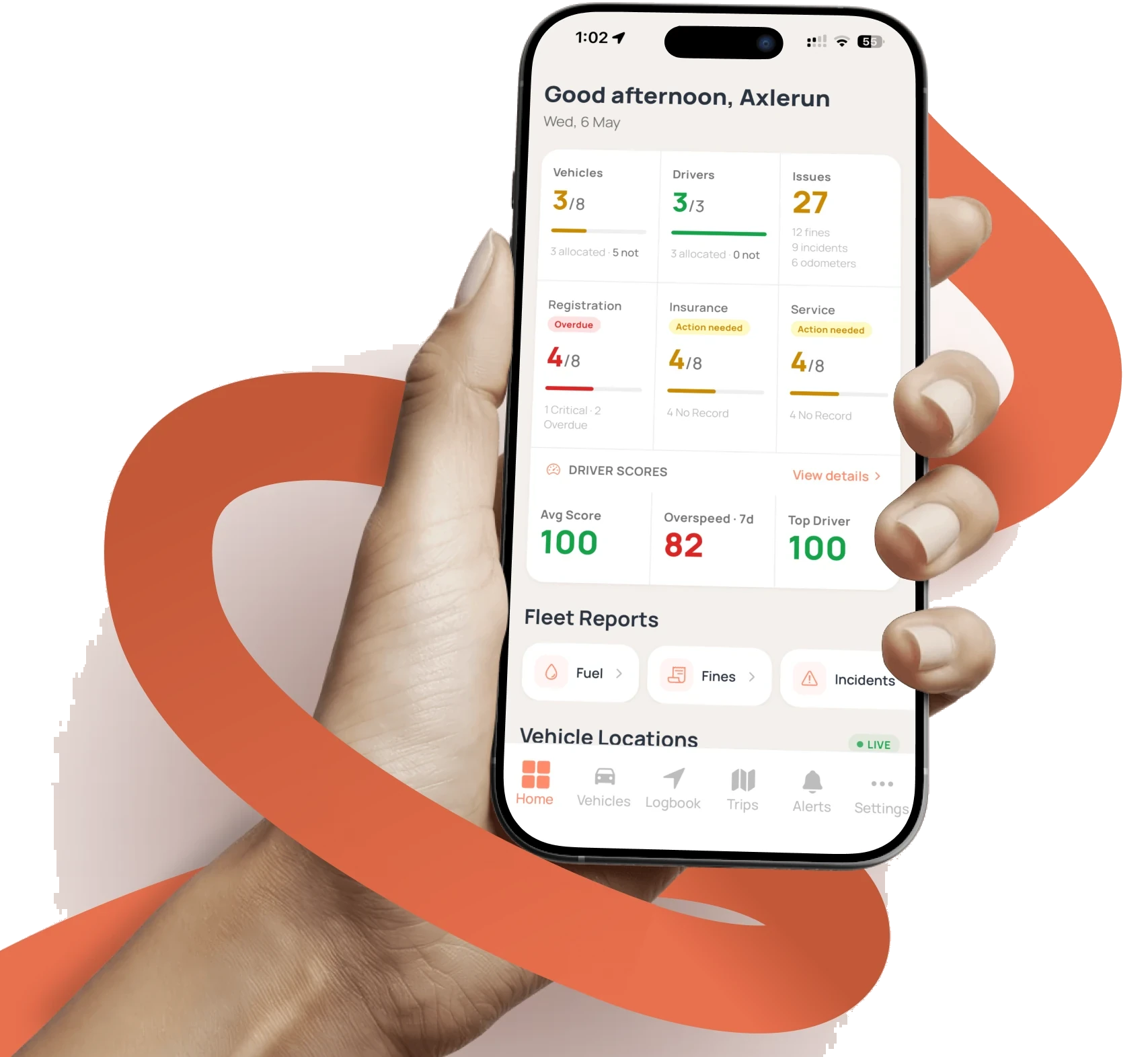
Recording that link as it happens is cheaper than reconstructing it. Axlerun stores toll tags and driver allocation against each vehicle on the free Drive plan — the first three vehicles are free forever — so a statement line has a driver and a trip beside it. On Cruise, fines are assigned to the driver on duty and toll costs can be tracked as vehicle expenses. Plenty of two-van businesses manage this fine in a spreadsheet; it is the fourth van that breaks it. If you want the trade-specific version, fleet admin for electrical contractors covers what else tends to pile up.
What to check before the next quarter
- The vehicle class recorded against every rego in your toll account, against the GVM on the compliance plate.
- Whether any van is regularly hitting the West Gate Tunnel City West exits between 7am and 9am.
- Whether a 24-hour pass is beating the trip cap on your heaviest-travel days, or costing you.
- Whether toll statements are being matched to drivers while anyone still remembers the week.
Frequently asked questions
Is a dual-cab ute a car or a light commercial vehicle on Melbourne toll roads?
It depends on how the vehicle is built, not what it is used for. Linkt classes a vehicle as a light commercial vehicle if it is a two-axle rigid vehicle with cab chassis construction and a gross vehicle mass greater than 1.5 tonnes but no more than 4.5 tonnes. Check the compliance plate for the GVM, then check the class recorded on your toll account.
Does towing a trailer change my toll class in Victoria?
No. Linkt states that vehicle class remains the same when towing a caravan or trailer, and its definition of a car explicitly covers a motor vehicle towing a trailer or caravan. A car towing a work trailer is still tolled as a car in Victoria. Other states classify trips differently, so check before you take a toll road interstate.
Can I claim Melbourne tolls as a business expense?
The ATO says you can claim a deduction for parking fees and tolls you incur when you use your car or other vehicle for work-related purposes. It also says you cannot claim tolls incurred travelling between home and work, because those are private expenses. Your own position depends on how the vehicle is used and how the business is structured, so confirm it with your accountant.
What is the West Gate Tunnel morning peak toll?
Inbound vehicles that use the City West exits — Footscray Road, Wurundjeri Way or Dynon Road — between 7am and 9am on weekdays pay a higher toll. As at the quarter ending 30 September 2026 that is $10.80 for a light commercial vehicle and $6.75 for a car, against $6.75 and $4.22 outside the window. Victorian public holidays are excluded.
What happens if a work vehicle uses CityLink with no toll account?
Linkt allows you to cover CityLink trips made up to five days earlier with a pass, or up to nine days earlier by opening an account. After that a toll invoice is issued to the registered owner of the vehicle with additional fees added, and unpaid toll invoices escalate to infringement notices. For a work vehicle the invoice goes to the business, not the driver.
How do I check whether my vehicle has been classified correctly?
Compare the class shown against each registration in your toll account with the compliance plate on the vehicle, which carries the gross vehicle mass. Linkt has confirmed that some vehicles in Victoria were incorrectly classified on CityLink and the West Gate Tunnel and asks anyone who thinks they are affected to call 1300 381 570.
Sources
- 1.CityLink Pass and Toll Prices, 1 July – 30 September 2026 — Linkt (Transurban)
- 2.West Gate Tunnel — light vehicles and toll pricing — Linkt (Transurban)
- 3.EastLink tolls, fees and amounts, valid 1 July 2026 until 30 June 2027 — ConnectEast (EastLink)
- 4.About vehicle classes — how vehicle classes work on toll roads — Linkt (Transurban)
- 5.Vehicle classification in Victoria — Linkt (Transurban)
- 6.How tolling works — covering past trips — Linkt (Transurban)
- 7.Expenses for parking, tolls, accidents, licence and fines — Australian Taxation Office
- 8.Cents per kilometre method — deductions for motor vehicle expenses — Australian Taxation Office
Axlerun is fleet software, not a tax agent. Rates and rules change — confirm anything that affects your return with your accountant or the ATO.
Fleet admin, minus the admin.
A short roundup a week — FBT, rego, fuel and fines — plus the occasional Axlerun update. No spam, unsubscribe any time.